Table of Contents
TogglePlanning to install recessed lighting? Expect to pay between $120 and $300 per fixture for professional installation in 2026, though that range widens considerably based on your home’s structure, the type of fixtures chosen, and whether you’re tackling new construction or cutting into existing ceilings. Understanding what drives these costs, from electrician labor rates to housing type, helps homeowners budget accurately and avoid sticker shock when quotes arrive. This guide breaks down real-world pricing across installation scenarios, fixture choices, and labor decisions so you can plan your lighting upgrade with confidence.
Key Takeaways
- The average cost to install recessed lighting ranges from $120–$300 per fixture professionally, with bulk installations of four or more typically dropping to $160–$200 per fixture.
- Ceiling accessibility is the biggest cost driver; finished ceilings without attic access can double installation time compared to open attics with easy electrician access.
- New construction recessed lighting installations cost 50–100% less than retrofit work because electricians access open framing before drywall, while retrofit jobs require cutting into finished ceilings and fishing wire through tight spaces.
- LED integrated housings cost more upfront ($20–$50) but save $6–$9 annually in electricity versus halogen fixtures, paying for themselves in just a few years.
- DIY installations can save $75–$150 per fixture in labor, but permits and code compliance are non-negotiable; most homeowners with six or more fixtures should hire a professional to ensure warranty coverage and avoid costly mistakes.
What Factors Affect Recessed Lighting Installation Costs?
Several variables influence the final price tag for recessed lighting, and most stem from what’s happening behind your ceiling.
Ceiling accessibility is the single biggest cost driver. An open attic above the installation area means electricians can walk across joists, run wire easily, and install fixtures from above, keeping labor costs down. Finished ceilings with no attic access require cutting holes, fishing wire through tight spaces, and sometimes opening additional access points for running cable, which can double installation time.
Housing type matters more than most homeowners expect. Vaulted ceiling installations typically cost 30-50% more than standard flat ceilings due to steeper angles, taller ladders, and limited access to wiring pathways. Cathedral ceilings often require specialty sloped-ceiling housings (IC-rated if near insulation) that run $10-30 more per fixture than standard cans.
Distance from the electrical panel affects material costs. Running 14/2 or 12/2 NM cable (Romex) to fixtures located far from existing circuits or the main panel adds wire cost and installation time. In some cases, the electrician may need to install a new circuit if your existing lighting circuit is already loaded near its 80% safe capacity threshold.
Fixture trim and bulb type create a wide pricing spread. Basic baffle trim with integrated LED housings start around $15-25 per fixture at home centers, while designer trims with adjustable eyeballs or gimbal rings can exceed $75 each. IC-rated (insulation contact) and airtight housings cost $10-40 more than non-IC models but are often required by code in insulated ceiling cavities.
Finally, local labor rates vary significantly by region. Metropolitan markets with higher costs of living typically see electrician rates of $85-150 per hour, while smaller markets may run $50-85 per hour. Most installations bill by the fixture or as a project rate rather than pure hourly, but these regional differences still show up in final quotes.
Average Cost Breakdown by Project Scope
National averages for professionally installed recessed lighting settle around $180-220 per fixture when installed in groups of four or more. That includes the housing, trim, bulb, wiring to the nearest junction point, and labor. Total project costs depend heavily on how many fixtures go in at once.
Single Light vs. Multiple Fixture Installation
Installing a single recessed light is rarely economical. Electricians typically charge a minimum service call fee of $100-200, which means one fixture could run $200-350 total, well above the per-fixture cost in bulk installations. The fixed costs (truck roll, setup, circuit testing) don’t scale down.
Four to six fixtures represent the sweet spot for value. Most electricians quote $160-200 per light at this quantity, bringing a typical living room installation (five fixtures) to $800-1,000 total. According to cost data from home improvement pricing guides, this range holds across most U.S. markets.
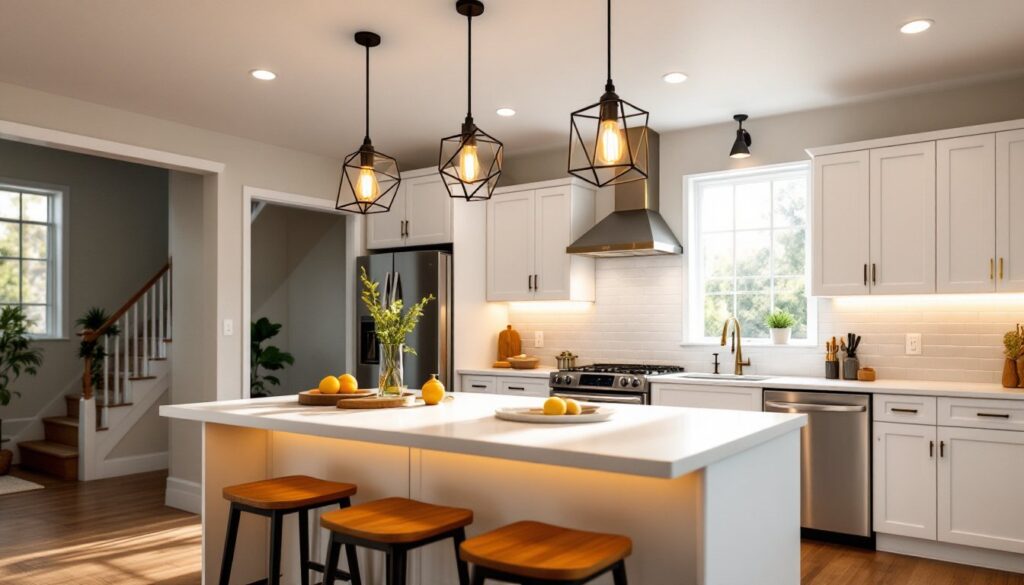
Eight or more fixtures often trigger volume discounts. Whole-home installations averaging 12-16 lights may drop to $140-180 per fixture, though total project costs of $2,000-3,500 require careful planning and phased work if budget is tight. Kitchens benefit from this scale since proper task lighting over counters and islands demands multiple 6-inch recessed fixtures spaced 4-6 feet apart.
Large-scale projects (20+ fixtures) sometimes shift to contractor pricing tiers, where per-fixture costs can dip below $130 but may require permits and electrical inspections depending on local code.
New Construction vs. Retrofit Installation Costs
The gap between new construction and retrofit pricing is significant, often 50-100% higher for retrofit work.
New construction installations happen before drywall goes up, giving electricians open stud bays and ceiling joists to work with. Wiring is straightforward, and housings mount directly to framing. Expect $60-100 per fixture in labor and materials when bundled with other rough-in electrical work. Builders often negotiate even lower rates when installing dozens of fixtures across a new home.
Retrofit (remodel) installations require cutting into finished ceilings, which introduces mess, precision cutting, and slower work. Remodel housings use spring-loaded clips that grab the drywall from behind rather than nailing to framing, and they cost $5-15 more per unit than new-work cans. Labor rates climb to $100-200 per fixture because electricians spend time protecting finished surfaces, fishing wire through closed cavities, and patching any exploratory cuts.
Attic access changes everything. A retrofit install with full attic access can approach new-construction pricing since the electrician works from above. No attic access, common in slab foundations or multi-story homes, forces all work from below and may require cutting additional access holes to run wire between joists, then patching and painting afterward.
Permitting costs are typically the same for both scenarios, though retrofit work in older homes may trigger code upgrade requirements if the existing electrical doesn’t meet current NEC standards (e.g., adding AFCI protection to bedroom circuits).
LED vs. Halogen: How Bulb Type Impacts Your Budget
Upfront fixture costs differ, but long-term expenses tilt heavily toward LEDs.
LED integrated housings (where the LED array is built into the fixture) cost $20-50 per unit for quality models. They’re more expensive upfront than halogen cans, but they pull 8-15 watts instead of 65-90 watts and last 25,000-50,000 hours. On a typical residential electric rate of $0.13-0.16 per kWh, an LED fixture costs about $1.50-3.00 annually to run if used four hours daily, compared to $9-12 for halogen.
Replacement factors matter: integrated LEDs can’t have bulbs swapped like traditional sockets. When the LED array fails (often 15-20 years out), the entire trim or housing may need replacing. But, retrofit LED kits that screw into existing sockets offer a middle ground, $12-30 per kit, easy DIY installation, and the flexibility to swap later.
Halogen recessed fixtures run $10-25 per housing and use standard BR30 or PAR30 bulbs ($4-8 each). They dim smoothly with basic dimmers and offer excellent color rendering (CRI 95+), which appeals to homeowners sensitive to light quality. But heat output is substantial, halogen cans require IC rating and proper clearance from insulation to prevent fire risk.
Dimmer compatibility adds cost regardless of bulb type. LED fixtures need LED-compatible dimmers ($20-45 installed), while halogens work with standard incandescent dimmers ($12-25). Installing dimmer switches during the initial project adds $30-60 per switch in labor.
DIY Installation vs. Hiring an Electrician
DIY recessed lighting installation can save $75-150 per fixture in labor, but it’s not a beginner-level electrical project.
Homeowners comfortable with electrical work can handle retrofit installations if they’re tapping into an existing ceiling junction box and the circuit has capacity. Materials cost $25-60 per fixture (housing, trim, wire, connectors), and the job requires a drill with a hole saw (4-inch or 6-inch depending on fixture size), wire strippers, a voltage tester, and basic hand tools. Allow 1.5-2 hours per fixture the first time through, faster once you’ve done a few.
Safety and code compliance are non-negotiable. All work must follow NEC guidelines: fixtures must be IC-rated if touching insulation, circuits shouldn’t exceed 80% of breaker capacity (12 amps on a 15-amp breaker), and all connections need proper wire nuts or push-in connectors inside rated junction boxes. Duct-taping Romex to a joist isn’t code-compliant and will fail inspection.
Most jurisdictions require permits and inspections for new circuits or adding multiple fixtures, even for DIY work. Permit fees run $50-150 depending on locality. Skipping permits risks failed home inspections during resale and potential insurance claim denials if faulty wiring causes a fire.
When to hire a pro: If the project requires running a new circuit from the panel, working in a ceiling with no attic access, or installing more than six fixtures, an electrician’s efficiency and insurance coverage justify the cost. For projects involving recessed lighting in living rooms or other high-traffic areas, professional installation ensures clean results and code compliance. According to contractor platforms, most homeowners choose professional installation for whole-room projects to avoid finish damage and ensure warranty coverage.
Additional Costs to Consider in Your Budget
Several expenses beyond fixture and labor costs can surprise homeowners mid-project.
Electrical panel upgrades become necessary when existing circuits lack capacity. Adding a dedicated 15-amp lighting circuit costs $150-400 depending on panel accessibility and wire run distance. Older homes with 100-amp service may need a full panel upgrade ($1,200-3,000) if adding recessed lighting alongside other kitchen or bathroom remodels.
Drywall repair and painting add $50-150 per room when retrofitting. Even skilled electricians create dust and may need to enlarge access holes to fish wire. Budget for spackle, sanding, primer, and touch-up paint, or hire a painter for $200-400 to handle finish work professionally.
Insulation work complicates attic installations. If existing insulation covers the installation area, it needs to be pulled back, then replaced after fixture installation. Compressed or damaged insulation reduces R-value, so plan on $1-2 per square foot to top off blown-in insulation if disturbed.
Dimmer switches and controls range from basic rotary dimmers ($15-25 installed) to smart dimmers compatible with Alexa or Google Home ($45-90 installed). Whole-room dimming requires a compatible system if controlling multiple zones.
Permit and inspection fees vary widely by jurisdiction, $50-200 for typical residential installations. Some municipalities include one re-inspection in the base fee: others charge $75-100 for each additional visit if corrections are needed.
Finally, project planning tools from home renovation resources help estimate total costs and compare contractor bids. Always get three quotes, verify licensing and insurance, and confirm warranty coverage on both fixtures and installation labor. Most reputable electricians warranty their work for one to two years, covering labor callbacks if fixtures fail due to installation errors.