Table of Contents
ToggleIf you’ve ever looked up at the night sky from your backyard and barely made out a handful of stars, you’re witnessing light pollution firsthand. Most outdoor lighting sends as much, or more, light sideways and upward as it does toward the ground where it’s actually needed. Dark sky compliant fixtures flip that equation. They direct light downward, cut glare, and reduce wasted energy. But beyond saving the night sky, these fixtures lower your electric bill, meet increasingly common municipal codes, and improve visibility around your property. This guide walks through what dark sky compliance means, why it matters for residential installations, and how to select and install fixtures that meet the standard without sacrificing safety or curb appeal.
Key Takeaways
- Dark sky compliant outdoor lighting directs light downward using full cutoff optics, eliminating upward and sideways light spill that causes light pollution and wastes energy.
- IDA-certified dark sky fixtures improve visibility by reducing glare, lower electric bills through efficient light concentration, and increasingly comply with municipal codes in suburban and observatory-adjacent areas.
- Choose warm color temperatures (2700K–3000K) over cool white LEDs to minimize sky glow and protect human circadian rhythms and wildlife migration patterns.
- Select appropriate fixtures for each zone—bollard lights for walkways, wall-mounted sconces for porches, recessed deck lights for patios, and adjustable dual-head floods for motion-sensor security lighting.
- Proper installation requires planning your layout in darkness, checking local codes, running dedicated circuits, mounting at correct heights (60–66 inches for wall sconces, 72–96 inches for post lights), and testing night visibility before final landscaping.
- Pair dark sky compliant fixtures with smart controls, photocells, or dimmable LEDs to further reduce energy consumption and automatically adjust outdoor lighting based on time and occupancy.
What Is Dark Sky Compliant Lighting?
Dark sky compliant lighting refers to fixtures certified by the International Dark-Sky Association (IDA), a nonprofit that sets standards to reduce light pollution. To earn IDA approval, a fixture must meet specific photometric requirements: zero lumens emitted at or above 90 degrees from vertical, and minimal light output between 80 and 90 degrees.
In plain terms, the fixture can’t send light upward or outward toward the horizon. All illumination stays below the horizontal plane, directed onto walkways, driveways, or landscaping.
The IDA evaluates fixtures based on laboratory test reports. Products that pass receive a Fixture Seal of Approval, which manufacturers display on packaging and spec sheets. Not all “dark sky friendly” claims are equal, look for the official IDA seal or reference to IDA certification, not just marketing language about “reduced light pollution.”
Most compliant fixtures use full cutoff optics, meaning the light source sits inside a housing that blocks upward and side spill. You’ll also see these called “fully shielded” fixtures. Semi-cutoff and cutoff fixtures allow some upward light and don’t qualify for IDA certification, though they’re still better than unshielded models.
Why Dark Sky Compliance Matters for Your Home
First, the practical reasons: glare reduction improves actual visibility. A poorly aimed floodlight creates bright spots and deep shadows, making it harder to see obstacles, steps, or people approaching. Shielded fixtures distribute light evenly across surfaces without blinding anyone who glances toward the source.
Second, energy efficiency. Unshielded fixtures waste lumens by throwing light where it’s not needed, into neighbors’ windows, tree canopies, and the sky. Dark sky fixtures concentrate output on target areas, so you can use lower-wattage bulbs (typically 8–15 watts LED for path lights, 15–25 watts for wall-mounted porch lights) and still achieve adequate illumination.
Third, code compliance. A growing number of municipalities, especially in suburban and rural areas near observatories or protected lands, require dark sky compliant fixtures for new construction and major renovations. Jurisdictions in Arizona, California, and parts of Colorado have adopted ordinances based on IDA standards. Check with your local building department before purchasing fixtures if you’re pulling a permit for exterior work.
Finally, ecological impact. Artificial light at night disrupts migration patterns in birds, confuses nesting sea turtles, and interferes with pollinator activity. While residential lighting isn’t the sole cause, cumulative effects across neighborhoods add up. Homeowners looking to reduce their environmental footprint often start with outdoor lighting as a straightforward, measurable improvement.
Key Features of Dark Sky Approved Fixtures
Shielding and Directional Design
The defining feature is a solid top and sides that prevent light escape above the horizontal plane. Most compliant fixtures use a metal or polymer housing with a flat or slightly recessed lens at the bottom.
Post-top fixtures (the kind you see on lamp posts) must have an integrated shield or opaque cap. Globe-style post lights, the classic “acorn” design, are almost never compliant because the bulb sits inside a translucent sphere that radiates light in all directions.
Wall-mounted sconces and porch lights should have a downward-facing aperture. The bulb socket sits above or behind the lens, so all output angles downward. Some models include a small backward spill to wash the wall behind the fixture, which is allowed as long as no light escapes upward.
Floodlights and spotlights need adjustable mounts that lock into position. Aim them below 45 degrees from vertical. Most IDA-approved floods include a cutoff hood or barn-door shield to block side spill.
If you’re retrofitting existing fixtures, aftermarket shields and hoods are available for some models, but photometric performance isn’t guaranteed. It’s usually cleaner to replace the entire fixture.
Color Temperature and Bulb Selection
Color temperature measured in Kelvin (K) affects both human circadian rhythms and wildlife. The IDA recommends 3000K or lower for residential outdoor use. Warmer tones (2700K–3000K) appear amber or soft white, similar to incandescent bulbs.
Cool white LEDs (4000K–5000K) emit more blue wavelengths, which scatter more in the atmosphere and contribute disproportionately to sky glow. They also suppress melatonin production in humans and disrupt insect navigation. Save cool white for task lighting in garages or workshops where color rendering matters.
Most dark sky fixtures ship with integrated LED modules rated for 25,000–50,000 hours. If you’re buying a fixture with a standard E26 socket, choose an A19 or BR30 LED bulb rated at 3000K or below. Check the bulb’s beam angle, narrow floods (25–40 degrees) work for spotlighting trees or architectural features, while wide floods (90–120 degrees) suit general area lighting.
Dimmable LEDs are worth the small upcharge. Pair them with a photocell or timer to drop output after midnight when foot traffic is minimal. Even at 50% brightness, most LEDs remain efficient and extend module life.
Avoid CFLs. They contain mercury, cycle poorly in cold weather, and have inconsistent color rendering. Halogen and incandescent bulbs generate excessive heat and rarely pair with the optics required for dark sky compliance.
How to Choose Dark Sky Lighting for Different Outdoor Areas
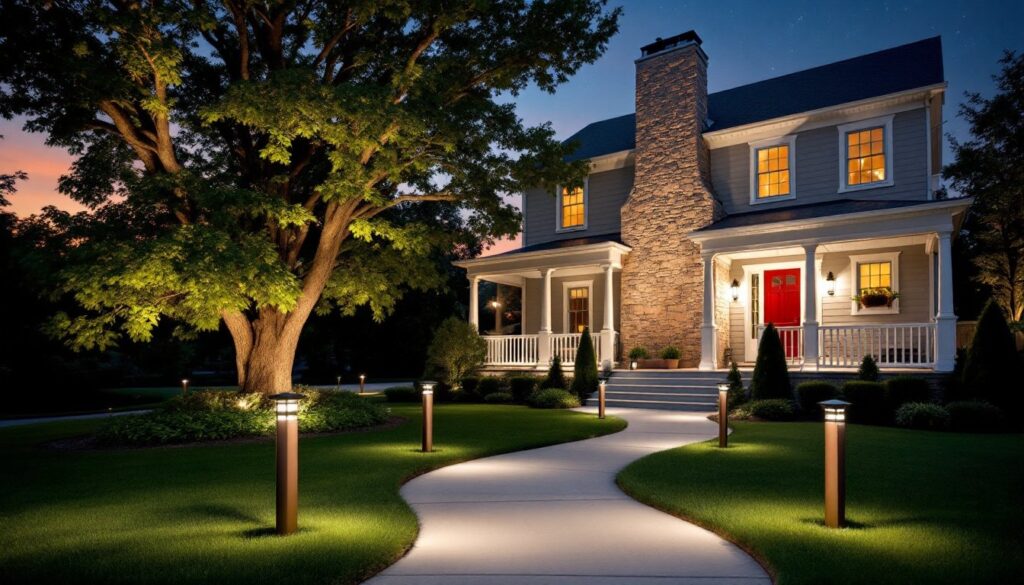
Driveways and walkways: Use bollard lights or low-profile path lights spaced 8–12 feet apart. Look for fixtures with 150–300 lumens per head. Taller bollards (24–36 inches) work along driveways: shorter units (12–18 inches) fit garden paths. Make sure the top is fully capped, no exposed bulbs.
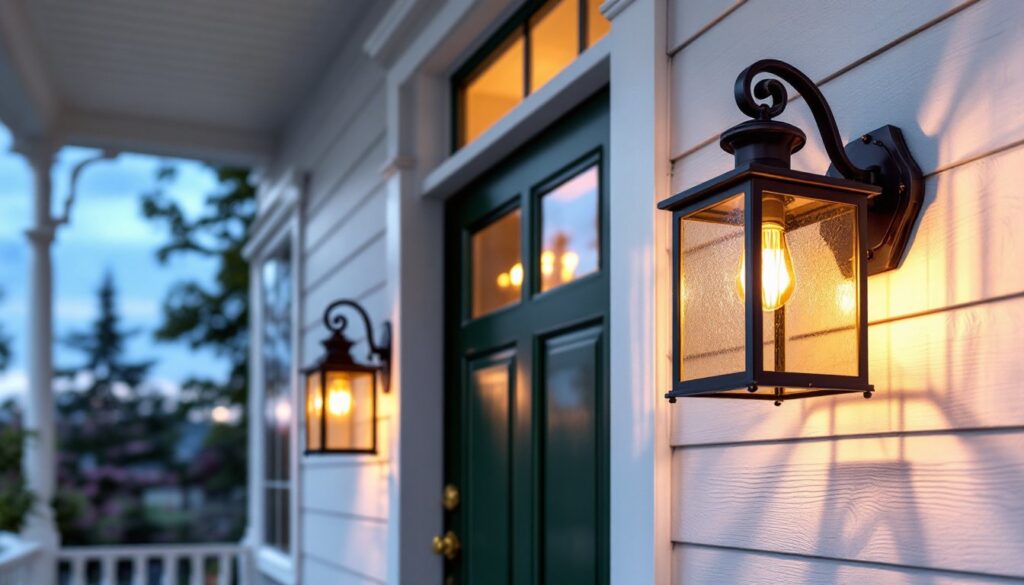
Porches and entryways: Wall-mounted lanterns with a downward-facing glass panel provide enough light for keyholes and faces without flooding the entire façade. Aim for 800–1200 lumens (roughly equivalent to a 60–75W incandescent). If the fixture is above 8 feet, add a second lower fixture or a recessed ceiling can light to reduce harsh shadows under the brim of hats or hoods.
Patios and decks: String lights and pendant fixtures are popular but rarely compliant. Instead, use recessed deck lights (installed flush in stair risers or post caps) or shielded step lights mounted under railings. Each should put out 50–100 lumens. For overhead coverage, a flush-mount ceiling fixture with a frosted diffuser and full shield works if the deck has a solid roof.
Security and motion-sensor lights: Opt for dual-head LED floods with adjustable mounts and motion detection. Position heads to aim at entry points, garage doors, side gates, basement windows, not at the sky or your neighbor’s bedroom. Set the motion sensor to a narrow detection angle and a short duration (30–60 seconds). Many smart home security systems now integrate dark sky compliant fixtures with app-based controls, letting you adjust sensitivity and schedules remotely.
Landscape and accent lighting: Bullet spotlights with integral shields work for uplighting trees or highlighting architecture. Install them close to the base of the target and angle them no more than 30 degrees from vertical to avoid spill. Use warm white (2700K) to preserve night vision. Advanced outdoor lighting controls can automate dimming schedules, reducing light levels as the evening progresses.
For water features or garden beds, well lights (recessed into the ground with a tempered glass cover) keep the source hidden and direct light upward only within a confined beam. They’re technically not dark sky certified because they emit upward, but when used sparingly and aimed at a focal object, not the open sky, they’re a reasonable compromise.
Installation Tips for Maximum Compliance and Efficiency
Plan your layout before buying fixtures. Walk the property after dark and note where light is actually needed versus where it’s just habit. Most homes are overlit. A well-placed 800-lumen fixture beats three poorly aimed 400-lumen units.
Check local codes and HOA covenants. Some jurisdictions limit fixture height, color temperature, or total lumens per acre. Homeowners associations may restrict fixture styles. Pull permits for any new wiring runs or structural mounts.
Run dedicated circuits for outdoor lighting. Use 12-gauge wire for runs over 50 feet to minimize voltage drop, especially with LED loads that are sensitive to fluctuation. Install a GFCI-protected outlet or breaker per National Electrical Code (NEC) Article 210.8. Low-voltage systems (12V or 24V) are easier to DIY and safer to troubleshoot, but require a transformer sized to handle total wattage plus 20% overhead.
Mount fixtures at the correct height and angle. Wall sconces should sit 60–66 inches above the finished grade for doorways, lower (48–54 inches) for pathway lighting. Post-top fixtures work best at 72–96 inches. Taller isn’t better, it increases glare and wastes lumens.
Wear safety glasses and gloves when drilling into brick, stucco, or masonry. Use a hammer drill with a masonry bit and plastic anchors rated for outdoor use. For wood siding, pre-drill pilot holes to prevent splitting. Seal all penetrations with outdoor-rated silicone caulk to prevent water intrusion.
Aim adjustable fixtures before final tightening. Turn the light on, step back 20 feet, and check for glare at eye level. If you can see the bulb or LED array directly, adjust the angle or add a louver. The goal is to see the illuminated surface, not the source.
Test the system at night before finishing trim and landscaping. Check for dark spots, excessive overlap, and unintended reflections off windows or glossy siding. Adjust spacing and orientation as needed. Once you’re satisfied, mulch around path lights and backfill post bases with gravel for drainage.
Consider timers, photocells, or smart controls. A basic photocell (under $15) turns lights on at dusk and off at dawn. Astronomic timers adjust on/off times daily based on sunrise and sunset, eliminating manual resets twice a year. Smart switches and hubs let you create zones, set dimming schedules, and override settings from your phone, useful if you’re extending a dinner party or returning late from a trip.