Table of Contents
ToggleColor changing LED landscape lighting has moved beyond the realm of commercial installations and theme parks. Today’s systems bring programmable, multicolor illumination to residential yards with surprising affordability and ease of installation. Whether someone wants to accent architectural features, highlight garden beds, or set the mood for outdoor entertaining, these fixtures offer flexibility that traditional landscape lighting can’t match. The technology has matured, too, better weather sealing, longer lifespans, and smartphone control are now standard features rather than premium add-ons. For homeowners willing to spend a weekend on installation, the payoff is a yard that adapts to seasons, holidays, and personal preference with a few taps on a screen.
Key Takeaways
- Color changing LED landscape lighting uses RGB or RGBW diodes to produce millions of colors electronically, eliminating the need to physically swap bulbs for different hues.
- These fixtures consume 75-80% less power than halogen alternatives and last 25,000 to 50,000 hours, delivering significant savings on energy bills and bulb replacements over a decade.
- Proper voltage planning is essential—use 12-gauge wire for runs up to 150 feet on 12V systems, or switch to 24V for longer distances to prevent voltage drop and ensure reliable operation.
- Quality connectors and waterproof junction boxes are critical for reliability; avoid twist-on wire nuts and use heat-shrink solder connectors or outdoor quick-connect systems to prevent corrosion.
- Stake fixtures loosely before final installation to evaluate placement, aim, and color effects after dark, then adjust spacing and positioning to achieve the desired lighting design.
- Smart color changing landscape lighting systems with Wi-Fi or Zigbee connectivity enable voice control, scheduling, and synchronized color changes across your entire yard through a smartphone app.
What Is Color Changing LED Landscape Lighting?
Color changing LED landscape lighting uses RGB (red, green, blue) or RGBW (RGB plus white) LEDs that can produce millions of color combinations by adjusting the intensity of each diode. Unlike single-color fixtures that require a complete bulb swap to change hues, these lights shift colors electronically through a controller, app, or automation system.
Most residential systems fall into two categories: standalone fixtures with built-in controllers and wired systems with a central hub. Standalone units operate independently via remote or Bluetooth app, making them ideal for small projects or renters. Wired systems connect multiple fixtures to a low-voltage transformer and controller, allowing synchronized color changes across an entire property.
The “smart” designation typically means Wi-Fi or Zigbee connectivity, enabling voice control through Alexa or Google Assistant and integration with broader home automation platforms. Not all color changing LEDs are smart, though, basic models use IR remotes or manual switches to cycle through preset colors.
These fixtures run on 12V or 24V AC/DC low-voltage power, fed by a transformer that steps down standard 120V household current. This lower voltage reduces shock hazards and simplifies DIY installation, though local electrical codes still apply, especially for transformer placement and wire burial depth.
Benefits of Installing Color Changing Landscape Lights
Energy efficiency tops the list. LEDs consume 75-80% less power than halogen landscape lights while lasting 25,000 to 50,000 hours. A typical 3-watt RGB LED fixture produces light output equivalent to a 20-watt halogen, translating to lower utility bills and fewer bulb replacements over a decade of use.
Seasonal adaptability eliminates the holiday decoration scramble. Program warm amber for autumn, red and green for December, pastels for spring, all without climbing ladders or stringing temporary lights. Many homeowners use this feature to coordinate with local sports teams, patriotic holidays, or charity awareness campaigns.
Security and ambiance in one system is another practical advantage. White light modes provide functional illumination for walkways and entryways, while colored accents create atmosphere for outdoor gatherings. Motion-activated settings can cycle to bright white when someone approaches, then return to decorative colors after a timeout period.
Property value perception gets a subtle boost. Well-executed landscape lighting, especially programmable systems that showcase mature trees, water features, or stonework, signals attention to detail. Real estate photographers love these installations because they create dramatic twilight shots that make listings stand out.
The customization factor appeals to homeowners who like to tinker. Scenes, schedules, and color palettes can be saved and recalled instantly. Testing different lighting schemes becomes a quick experiment rather than a rewiring project.
Types of Color Changing LED Landscape Fixtures
Spotlights and uplights handle the heavy lifting for accent work, lighting tree canopies, columns, or exterior walls. Look for models with adjustable beam angles (15° to 60° is common) and ground stakes rated for soil installation. Housing should be IP65 or IP67 rated for protection against rain and irrigation spray. Wattage typically ranges from 3W to 12W per fixture.
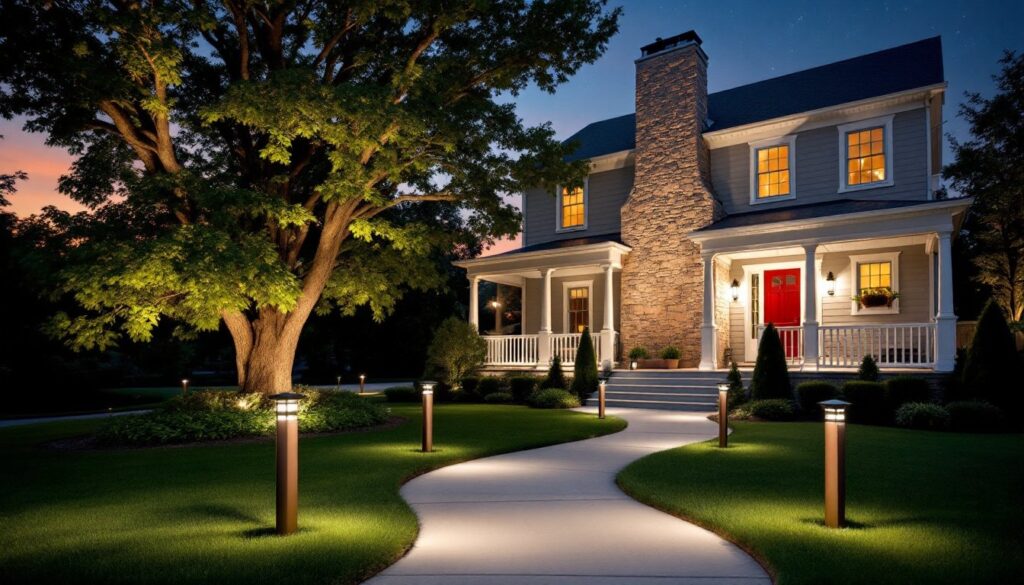
Path and bollard lights line walkways, driveways, and garden borders. These shorter fixtures (12 to 24 inches tall) cast downward illumination to define edges without blinding anyone walking past. Color changing versions let homeowners switch from practical white for everyday use to decorative hues for events. Make sure the lens is shielded or frosted to prevent glare.
Strip lights and rope lights tackle linear applications: under deck railings, along fence tops, or outlining architectural features. These flexible fixtures use adhesive backing or mounting clips and connect via waterproof connectors. RGB strip lights rated for outdoor use have silicone or PVC coatings and should carry an IP rating of at least IP65. Standard 16-foot reels are common, with options to cut at designated intervals (usually every 3 or 6 inches).
Well lights and in-ground fixtures get installed flush with hardscapes or turf. They’re ideal for uplighting small trees, statuary, or signage. Installation requires 3 to 6 inches of excavation and proper drainage consideration, trapped water will corrode wiring and shorten lifespan. Use fixtures with removable lenses for easier lamp replacement if needed, though LEDs rarely burn out before ten years of use.
Flood and wash lights cover broad areas, facades, retaining walls, or large shrub beds. These fixtures typically output 500 to 1,200 lumens and feature wider beam spreads (60° to 120°). They’re overkill for subtle accent work but excel when dramatic color washes are the goal.
How to Choose the Right Color Changing LED System for Your Yard
Start by mapping light zones. Walk the property at dusk and identify what needs illumination: entryways, paths, focal plants, architectural features. Count how many fixtures each area requires and measure approximate cable runs from the transformer location to the farthest fixture. This informs wire gauge selection and transformer capacity.
Voltage drop becomes critical on runs longer than 100 feet. Use 12-gauge wire for runs up to 150 feet on 12V systems: beyond that, consider stepping up to 10-gauge or switching to a 24V system, which suffers less voltage drop over distance. Online voltage drop calculators help dial this in based on total wattage and run length.
Controller compatibility matters if integrating with existing smart home systems. Home automation platforms like SmartThings, Home Assistant, or Apple HomeKit require specific protocols. Check whether fixtures use Wi-Fi, Zigbee, Z-Wave, or proprietary hubs. Wi-Fi fixtures are easiest to set up but can congest router bandwidth if deploying dozens of lights. Zigbee and Z-Wave use mesh networks that actually strengthen as more devices are added.
Lumen output and color rendering deserve attention. A 3W RGB fixture typically outputs 200 to 300 lumens, adequate for accent lighting but insufficient for area illumination. For pathways or security applications, look for RGBW fixtures that include dedicated white LEDs with higher lumen output and better color rendering index (CRI) values, 80+ CRI shows colors more accurately than RGB-mixed white.
Warranty and support separate quality manufacturers from budget importers. Look for at least a 3-year warranty on electronics and 5 years on LED components. Companies that provide replacement parts, firmware updates, and responsive tech support save headaches down the line. Budget fixtures often lack UL or ETL listing, which can void homeowner’s insurance if a fire or electrical issue.
Installation Tips for DIY Homeowners
Safety first: Turn off power at the breaker before connecting transformers. Wear safety glasses when using shovels or augers near buried utilities. Call 811 or the local utility locating service at least two days before digging, hitting a gas or power line turns a weekend project into an emergency.
Transformer placement is governed by local electrical code, but typical requirements include mounting at least 12 inches above grade, within 24 inches of a GFCI-protected outlet, and never in a location where it can be submerged. Garages, covered patios, and exterior wall-mounted weatherproof boxes are common spots. Size the transformer to handle 80% load capacity, if total fixture wattage is 100W, use at least a 125W transformer to prevent overheating.
Wire burial depth varies by jurisdiction, but the IRC generally requires 6 inches minimum for low-voltage landscape lighting wire when installed in conduit or rated for direct burial. Some municipalities require 12 inches. Use UF-rated or direct-burial landscape wire, standard lamp cord degrades quickly underground. Lay wire in gentle curves rather than sharp angles to reduce stress on connections.
Connector quality makes or breaks long-term reliability. Twist-on wire nuts don’t cut it outdoors. Use heat-shrink solder connectors or waterproof wire nuts filled with dielectric grease. Many pros prefer quick-connect systems from manufacturers like Wago or lever-lock connectors designed for outdoor use. Bury connections inside weatherproof junction boxes rather than leaving them exposed in the ground.
Fixture placement benefits from trial runs before final installation. Stake lights loosely in position, connect them, and evaluate the effect after dark. Adjust spacing, aim, and color before committing to permanent mounting. For uplighting trees, start with the fixture 12 to 18 inches from the trunk and adjust outward or inward based on canopy spread and desired effect.
App setup and programming should happen after physical installation is complete. Most systems require firmware updates out of the box, do this over a strong Wi-Fi signal before mounting the controller in a permanent outdoor location. Create labeled zones (“Front Path,” “Oak Tree,” “Patio Wall”) in the app to simplify scene programming. Save at least one scene with full white output for security or utility use.
Creative Ways to Use Color Changing Landscape Lighting
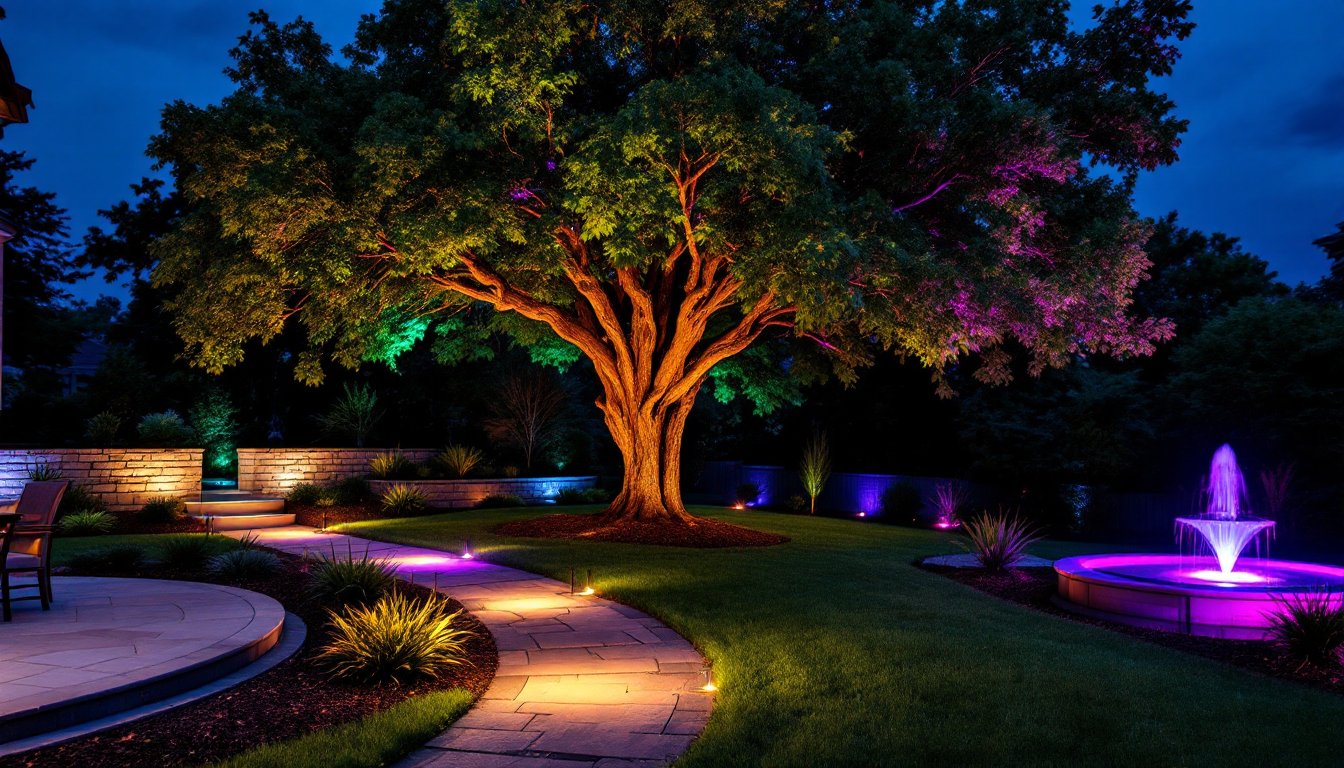
Tree canopy highlighting using multiple uplights creates depth and drama. Place fixtures at staggered distances from the trunk, one close for bark texture, others farther out to catch branch structure. Program seasonal colors: fiery reds and oranges in autumn, cool blues and purples in summer.
Water feature illumination benefits from color changing LEDs submerged or aimed at flowing water. Fountains, ponds, and waterfalls take on entirely different personalities with shifting hues. Ensure fixtures are rated for submersion (IP68) and use stainless steel or marine-grade housings to prevent corrosion. Many outdoor smart lights now include underwater-rated options with synchronized color programs.
Pathway gradients guide guests with color cues. Program path lights to transition from warm white near the house to cooler tones as the path leads toward a patio or garden focal point. For parties, sync pathway colors to music using compatible controllers, though this gimmick wears thin quickly, it’s a hit for special occasions.
Holiday automation goes beyond red and green. Program Valentine’s pinks, Independence Day patriotic sequences, or Halloween oranges and purples. Set schedules to activate at sunset and turn off at a reasonable hour to avoid annoying neighbors. Geofencing features in some apps turn lights on automatically when residents arrive home after dark.
Architectural washing uses wall-mounted or in-ground floods to bathe facades in color. Coordinate hues with interior lighting visible through windows for a unified effect. Brick, stone, and stucco all reflect colors differently, test settings before committing to scenes. Avoid blasting bright colors toward neighbors’ properties or windows.
Garden bed borders traced with RGB strip lights create clean edges and highlight plantings after dark. Mount strips along raised bed frames, retaining walls, or planter edges using aluminum channels designed for outdoor LED strips. This technique works particularly well for vegetable gardens, where color changing LEDs can shift to red wavelengths that allegedly promote plant growth (though scientific support for this in outdoor settings is thin).
Many outdoor lighting systems now feature integration with weather data, automatically adjusting brightness and color temperature based on ambient light levels, moon phase, or even local sports team scores, useful for superfans and a conversation starter for everyone else.
Conclusion
Color changing LED landscape lighting delivers more than visual novelty, it’s a practical upgrade for homeowners who want adaptable outdoor spaces without the ongoing cost and maintenance of traditional fixtures. DIY installation is within reach for anyone comfortable running low-voltage wire and following local electrical codes. The real payoff comes months later, when adjusting the entire yard’s ambiance takes seconds instead of an afternoon with a ladder and a box of bulbs.