Table of Contents
ToggleDome pendant lighting has been a go-to for homeowners and designers for decades, and for good reason. The clean, curved silhouette works in nearly any space, from farmhouse kitchens to minimalist lofts, and provides focused, functional light exactly where it’s needed. Unlike flush-mount ceiling fixtures that wash a room in diffuse light, dome pendants direct illumination downward, making them ideal for task lighting over islands, dining tables, and workspaces. They’re also surprisingly versatile: swap the finish, size, or material, and the same basic shape reads completely differently. Whether someone’s updating a single fixture or planning a full lighting overhaul, understanding how dome pendants work and where they shine makes the difference between a room that feels finished and one that just looks lit.
Key Takeaways
- Dome pendant lighting directs light downward to provide focused task lighting, making it ideal for kitchen islands, dining tables, and workspaces while reducing glare and improving visibility.
- Dome pendants come in multiple styles—including metal, glass, and oversized options—allowing homeowners to choose finishes and sizes that match industrial, farmhouse, minimalist, or contemporary interiors.
- For proper sizing, a single kitchen island pendant should be roughly one-third the width of the island, and hanging height should be 30 to 36 inches above surfaces like dining tables and work areas.
- Dome pendant lighting works best in task-oriented rooms such as kitchens, dining areas, entryways, and home offices, but should be paired with recessed cans or sconces for layered, flexible illumination.
- Installation of dome pendant lights is a manageable DIY project for homeowners familiar with basic electrical wiring, requiring proper power shutdown, voltage testing, and secure wire connections.
- Thoughtful styling—such as matching metals to existing hardware, using contrast for visual impact, and grouping pendants in odd numbers—transforms dome pendants into cohesive design elements that enhance any interior.
What Is Dome Pendant Lighting and Why It’s a Timeless Choice
A dome pendant is a ceiling-mounted light fixture that hangs from a rod, chain, or cord and features a dome-shaped shade. That shade, whether metal, glass, or another material, curves downward to enclose the bulb and direct light toward the surface below. The fixture can be as small as 6 inches in diameter for accent lighting or as large as 24+ inches for dramatic statement pieces.
The appeal comes down to function and form. Functionally, the dome shape focuses light downward, reducing glare and improving visibility for tasks like chopping vegetables or reading blueprints. Aesthetically, the smooth curve softens angular spaces and pairs well with both traditional and contemporary interiors. Dome pendants first gained traction in industrial and commercial settings, think warehouse shades and schoolhouse globes, but quickly migrated into residential design as homeowners sought fixtures that balanced utility with style.
Unlike chandeliers or multi-light pendants that serve as focal points, dome pendants are workhorses. They don’t demand attention, but they don’t disappear, either. That restraint is part of why they’ve remained popular for over a century. A well-chosen dome pendant adapts to evolving trends without looking dated, which makes it a smart long-term investment for anyone updating their home’s lighting infrastructure.
Types of Dome Pendant Lights for Every Room and Style
Dome pendants come in several distinct styles, each suited to different design goals and functional needs.
Metal dome pendants are the most common. Finishes range from matte black and brushed nickel to oil-rubbed bronze and polished brass. Metal shades are durable, easy to clean, and block all upward light, making them ideal for task-focused areas. They work well in industrial, farmhouse, and mid-century modern spaces.
Glass dome pendants offer a softer look. Clear glass shows off vintage Edison bulbs or decorative filament styles, while frosted or seeded glass diffuses light for a gentler glow. Glass domes suit transitional, coastal, and Scandinavian interiors where a lighter touch is needed.
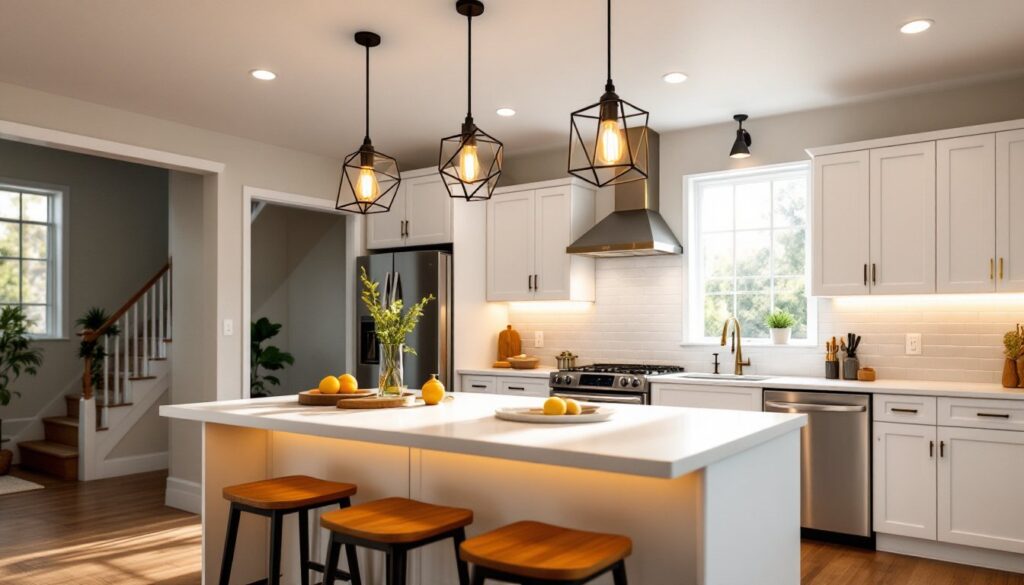
Dome pendant lights for kitchen island applications are often sold in sets of two or three to provide even illumination across a long workspace. These fixtures typically have 8- to 12-inch diameters and hang at adjustable heights to accommodate varying ceiling clearances. They’re wired either to a single junction box with a multi-light canopy or to separate boxes spaced evenly along the island’s centerline.
Oversized dome pendants, those measuring 18 inches or larger, make bold statements in open-concept layouts. These fixtures can define zones within a large room, such as anchoring a breakfast nook or highlighting a Light Fixtures That Transform entryway. Larger domes often require heavier-duty mounting hardware and may need blocking installed between ceiling joists to support the added weight.
Adjustable-height pendants use a pulley system or telescoping rod, allowing homeowners to raise or lower the fixture as needed. This flexibility is helpful in spaces with vaulted ceilings or when the table height changes (bar-height vs. standard dining).
How to Choose the Right Size and Height for Your Space
Getting the proportions right is critical. A pendant that’s too small disappears: one that’s too large overwhelms the room and creates headroom issues.
Diameter sizing starts with the surface below. For a kitchen island, a single pendant should be roughly one-third the width of the island. If using multiple pendants, each fixture can be smaller, typically 8 to 12 inches in diameter, and spaced 24 to 30 inches apart on center. For dining tables, add the table’s length and width in feet, then convert that sum to inches for a general fixture diameter. A 6-foot by 3-foot table (6 + 3 = 9) pairs well with a pendant around 9 to 12 inches in diameter, though style and ceiling height can shift that number.
Hanging height follows a simple rule: 30 to 36 inches above the surface for islands and dining tables. This range provides adequate task lighting without obstructing sightlines across the table. In rooms with ceilings higher than 8 feet, add 3 inches of drop for every additional foot of ceiling height. For example, a 10-foot ceiling calls for a drop of roughly 36 to 42 inches above the table.
Always measure from the bottom of the shade to the surface, not from the canopy. Adjustable-cord pendants make this easy to dial in after installation. If the pendant hangs in a walkway or over a kitchen island where people stand, maintain at least 6 feet 8 inches of clearance from the floor to the bottom of the fixture to avoid head-bumping.
For open-concept spaces or rooms with multiple pendants, consider scale in relation to other fixtures and furnishings. A single oversized dome pendant works beautifully in a two-story entryway, but the same fixture would dominate a low-ceilinged breakfast nook. Balance is key.
Best Rooms and Locations for Dome Pendant Lighting
Dome pendants excel in task-oriented settings where focused light improves function and safety.
Kitchen islands are the most popular application. A row of two or three dome pendants provides even, shadow-free illumination for meal prep, assignments, and casual dining. The downward throw of light also keeps glare out of the cook’s eyes while working at the island.
Dining rooms benefit from a single statement pendant or a cluster of smaller domes hung at varying heights for visual interest. Dimmer switches are essential here: they allow the homeowner to shift from bright task lighting during dinner prep to softer ambient light during the meal.
Entryways and foyers gain drama from oversized dome pendants, especially in homes with two-story entries or vaulted ceilings. A large metal dome in a bold finish draws the eye upward and sets the tone for the rest of the home.
Home offices and craft rooms need focused task lighting, and dome pendants deliver without the clinical feel of recessed cans. Mounting a pendant directly over a desk or worktable reduces eye strain and creates a defined workspace.
Bedside lighting can also work with smaller dome pendants hung as an alternative to table lamps. This approach frees up nightstand space and adds a modern touch to traditional bedroom layouts. Just ensure the bottom of the fixture sits 18 to 24 inches above the mattress to avoid accidental contact.
Avoid using dome pendants in rooms where upward or ambient lighting is needed, such as living rooms with dark ceilings or hallways requiring wall-to-wall illumination. Recessed lighting or semi-flush mounts are better suited to those applications.
Step-by-Step Installation Guide for DIY Homeowners
Installing a dome pendant is a manageable DIY project for anyone comfortable working with basic electrical wiring. Always turn off power at the breaker, not just the wall switch, and verify it’s off with a non-contact voltage tester before touching any wires.
Tools and materials:
- Non-contact voltage tester
- Wire strippers
- Screwdrivers (flathead and Phillips)
- Adjustable wrench or pliers
- Ladder rated for the ceiling height
- Wire nuts (usually included with the fixture)
- Electrical tape
- Safety glasses
Step 1: Turn off power and remove the old fixture. Flip the breaker, then test the wiring with the voltage tester. Unscrew the old fixture’s canopy, disconnect the wire nuts, and remove the mounting bracket.
Step 2: Install the new mounting bracket. Most dome pendants use a crossbar that screws into the existing junction box. If the box isn’t rated for the fixture’s weight (check the fixture specs, most range from 5 to 15 pounds), replace it with a fan-rated or heavy-duty box anchored to a ceiling joist or blocking.
Step 3: Thread the pendant’s wires through the canopy. Adjust the cord or chain to the desired length before making electrical connections. Some fixtures allow cord length adjustment after installation, but it’s easier to set it now.
Step 4: Connect the wiring. Match wire colors: black (hot) to black, white (neutral) to white, and bare copper or green (ground) to the ground screw or wire. Twist wires together clockwise, secure with wire nuts, and wrap the base of each nut with electrical tape for added security.
Step 5: Attach the canopy and install the bulb. Tuck the wires into the junction box, then secure the canopy with the provided screws. Screw in the appropriate bulb, most dome pendants use standard A19 or vintage Edison-style bulbs. Check the fixture’s maximum wattage rating, typically 60 to 100 watts for incandescent or equivalent LED.
Step 6: Restore power and test. Flip the breaker, then turn on the switch. If the light doesn’t work, turn off the breaker and double-check wire connections.
If installing multiple pendants on one switch, they’ll typically share a single junction box with a multi-light canopy or run to separate boxes on the same circuit. Verify the circuit’s amperage rating (usually 15 or 20 amps) can handle the combined load. If adding new junction boxes, consult local building codes, electrical work often requires a permit and inspection.
Styling Tips: Pairing Dome Pendants with Your Interior Design
Dome pendants adapt to almost any aesthetic, but thoughtful pairing with finishes, colors, and surrounding decor elevates the result.
Match metals to hardware. If cabinet pulls, faucets, and door hardware are brushed nickel, a matching nickel dome pendant creates cohesion. Mixing metals is acceptable, even encouraged in eclectic spaces, but limit it to two or three finishes to avoid a chaotic look.
Use contrast for impact. A matte black dome pendant pops against white shiplap or subway tile, while a brass or copper finish warms up cool gray cabinetry. Contrast doesn’t mean clash: it means intentional difference that highlights both elements.
Layer lighting for depth. Dome pendants provide task lighting, but they shouldn’t be the only light source. Pair them with recessed cans for general illumination, under-cabinet strips for counter tasks, and sconces or table lamps for ambient warmth. This layered approach creates a more livable, flexible space.
Consider bulb choice. Exposed-bulb fixtures show off vintage Edison or globe-style bulbs, which add character but often produce warm, lower-lumen light. If high task lighting is needed, opt for a frosted glass dome that can house a brighter LED while diffusing the glare.
Scale to the room’s style. Industrial and farmhouse interiors handle bold, oversized domes with ease, while Scandinavian and minimalist spaces benefit from smaller, understated fixtures in muted tones. When in doubt, the design trends on domino.com and contemporary inspiration at designmilk.com offer real-world examples of how different styles approach pendant lighting.
Group pendants in odd numbers. Two pendants can feel static: three or five create rhythm and visual interest. Vary the height slightly if the ceiling allows, it adds an organic, curated feel without sacrificing function.
Conclusion
Dome pendant lighting offers a rare combination of form, function, and flexibility. Whether illuminating a kitchen island, anchoring a dining room, or adding character to an entryway, these fixtures deliver focused light without sacrificing style. Choosing the right size, height, and finish ensures the pendant enhances the space rather than fighting it. And with straightforward installation and endless design possibilities, dome pendants remain one of the smartest, and most timeless, lighting choices a homeowner can make.