Table of Contents
ToggleCrystal pendants aren’t just for formal dining rooms anymore. Modern iterations blend traditional sparkle with clean lines, geometric forms, and adaptable finishes that work in everything from industrial lofts to farmhouse kitchens. If you’re weighing whether to swap out that builder-grade fixture, the right crystal pendant can shift a room’s entire character while providing functional task lighting. This guide breaks down what makes today’s crystal pendants different, where they work best, and how to size, install, and maintain them without hiring outside help.
Key Takeaways
- Modern crystal pendant lighting combines minimalist design with integrated LED technology, using lightweight materials like K9 optical crystal instead of heavy lead-glass to simplify installation.
- Kitchen islands and dining tables are ideal locations for crystal pendants, with fixtures hung 30–36 inches above countertops and 30–34 inches above tables for optimal task lighting and visual appeal.
- Proper sizing follows the room formula—add length and width in feet, then convert to inches for fixture diameter—but prioritize functional spacing over formulas for island and task applications.
- Installation requires cutting power at the breaker, matching wire connections carefully, and securing the junction box with hardware rated for the fixture’s weight; DIY installation is feasible if you’re comfortable with electrical work.
- Quarterly maintenance including dusting, deep cleaning with distilled water and vinegar solutions, and annual wiring inspections will keep your crystal pendant sparkle bright and functional for a decade or more.
- Crystal pendants work best in open-plan spaces when paired with recessed lighting and wall sconces, and finishes should match adjacent fixtures for visual flow across rooms.
What Makes Crystal Pendant Lighting Modern?
Traditional crystal chandeliers lean ornate, think brass arms, cascading teardrops, and fixtures meant to anchor a two-story foyer. Modern crystal pendants strip that down. You’ll see:
- Minimalist frames: Brushed nickel, matte black, or satin brass housings instead of polished gold or bronze.
- Geometric shapes: Linear bars, globe silhouettes, or drum shades with embedded crystals.
- Integrated LED modules: Many 2026 models ship with built-in LED arrays rated for 25,000+ hours, eliminating bulb changes and reducing heat output.
- Mixed materials: Crystal paired with natural wood, concrete bases, or industrial metal cages.
The crystal itself often skips heavy lead-glass prisms in favor of K9 optical crystal or premium acrylic that refracts light without the weight. This matters during installation, you’re not wrestling a 40-pound fixture onto a standard junction box.
Designers featured on Design Milk frequently showcase pendants that use crystal as an accent rather than the sole focus, layering texture without overwhelming minimalist interiors. If your home leans mid-century or Scandinavian, look for pendants where the crystal sits inside a matte or wooden drum shade, diffusing light while adding subtle sparkle.
Best Rooms for Modern Crystal Pendant Fixtures
Kitchen Islands and Dining Areas
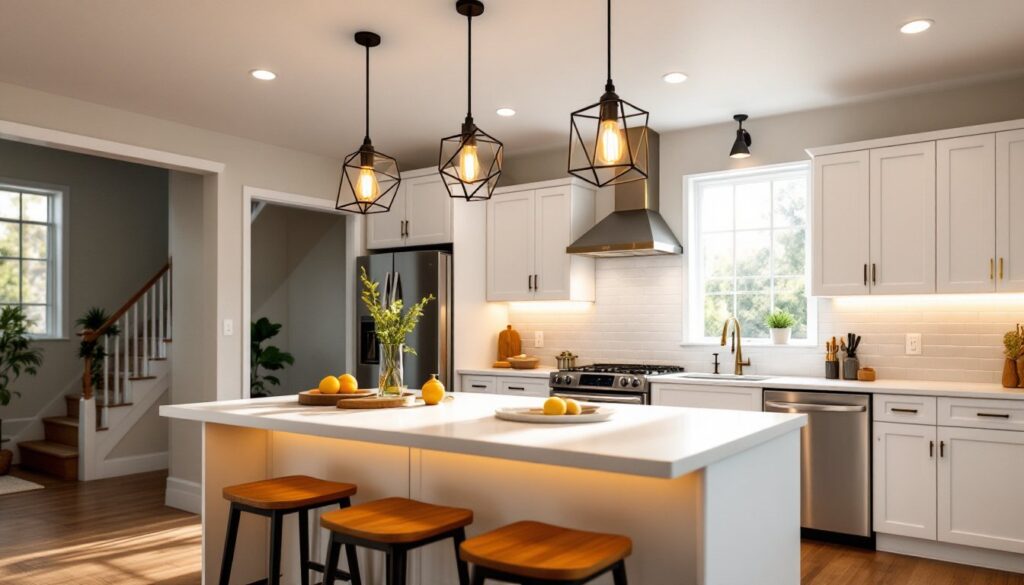
This is the most common install zone, and for good reason. A row of two or three pendants over a kitchen island provides task lighting at 30–36 inches above the countertop, standard clearance for prep work without head-bumping. For a typical 6-foot island, budget 18–24 inches between pendant centers and at least 6 inches from the edge of the countertop.
Crystal pendants excel here because they layer ambient light with focused downlight. Choose fixtures with open bottoms (no solid shade underneath) if you need direct illumination for chopping or reading recipes. If the island doubles as a casual dining spot, opt for dimmable LEDs or compatible bulbs on a dimmer switch, you’ll want brighter light for meal prep and softer tones during dinner.
Over a dining table, hang a single large pendant or a linear fixture centered on the table, not the room. The bottom of the fixture should sit 30–34 inches above the table surface. Too high, and you lose intimacy: too low, and guests can’t see each other.
Entryways and Living Spaces
An entryway pendant sets tone immediately. In a standard 8-foot ceiling space, a fixture 20–24 inches in diameter works without crowding sightlines. For two-story foyers, you can go larger, 36 inches or more, but confirm your junction box is rated for the weight. Boxes rated for ceiling fans (typically 50 pounds) handle most crystal pendants, but verify before you commit.
In living rooms, pendants work best over coffee tables, reading nooks, or conversation areas rather than dead-center ceiling mounts. Pair them with recessed cans or wall sconces for layered lighting. Crystal catches both natural daylight and artificial sources, so a well-placed pendant near a window multiplies perceived brightness without added wattage. Contemporary interiors often feature luxury lighting that balances decorative appeal with functional beam spread.
Choosing the Right Size and Style for Your Space
Sizing formulas exist, but they’re guidelines, not gospel. A common rule: add room length and width (in feet), then convert that sum to inches for fixture diameter. A 12×14-foot dining room suggests a 26-inch pendant. That works for centered ceiling fixtures. For island or task lighting, prioritize functional spacing over the formula.
Key measurements to confirm before buying:
- Ceiling height: Standard 8-foot ceilings limit pendant drop to around 18–24 inches including the canopy. Vaulted or 10-foot ceilings allow longer drops and larger fixtures.
- Adjustable cord/chain: Most pendants ship with 6–10 feet of cord. You’ll trim or loop excess inside the canopy, but check whether the design allows shortening without voiding warranty.
- Bulb type and wattage: Integrated LED fixtures list lumens (aim for 800–1,100 lumens per pendant for task lighting). Socket-based models specify max wattage, don’t exceed it. Overheating can damage crystal facets or warp frames.
Style-wise, match the pendant’s finish to other light fixtures in adjacent rooms for visual flow. If your kitchen faucet and cabinet pulls are brushed nickel, a brass crystal pendant will clash unless you’re intentionally mixing metals (a valid 2026 trend, but it requires confidence).
For open-plan spaces, consider how the pendant reads from multiple angles. A fixture stunning from below might look awkward from a second-floor hallway or loft overlook. Walk your space with a tape measure and visualize sightlines before ordering.
Installation Tips for Crystal Pendant Lights
Safety first: Cut power at the breaker, not just the wall switch. Use a non-contact voltage tester to confirm wires are dead before touching anything.
Most pendant installs follow the same sequence:
- Remove the old fixture and inspect the junction box. If it’s loose, wobbly, or a plastic retrofit box, replace it with a metal pancake box or adjustable bar rated for the new fixture’s weight.
- Assemble the pendant hardware per instructions. Many crystal models ship partially assembled to prevent damage: you’ll attach the canopy, thread the cord, and connect crystals or shades on the ground.
- Wire connections: Match black (hot) to black, white (neutral) to white, and bare copper (ground) to green or bare. Use wire nuts rated for the wire gauge (usually 14 or 12 AWG). Twist wires clockwise, cap firmly, and tug-test each connection.
- Mount the canopy to the junction box using the provided screws. If the pendant uses a threaded nipple and crossbar, hand-tighten the nipple into the crossbar, then secure the crossbar to the box with machine screws.
- Hang and level the fixture. Some pendants have adjustable-height mechanisms: others require you to shorten the cord inside the canopy. Loop excess neatly, don’t kink or crush it.
- Attach crystals last to avoid fingerprints. Cotton gloves help.
Tools you’ll need:
- Voltage tester
- Wire strippers
- Screwdriver set (Phillips and flathead)
- Ladder tall enough to work comfortably
- Needle-nose pliers (for bending wire leads)
If the existing box is off-center or you’re adding a pendant where none existed, you’ll need to cut drywall, install a new box between joists, and patch. That’s a half-day job for a confident DIYer. If you’re not comfortable working with electrical wiring or if local code requires a licensed electrician for new circuits (some jurisdictions do), call a pro.
Dimmer compatibility: Not all LEDs dim smoothly. Check the fixture’s spec sheet for compatible dimmer models. Older rotary or slide dimmers often cause flicker or buzzing with LED loads. Modern interiors shown on Domino frequently highlight smart dimmers that integrate with home automation systems for preset scenes.
Maintenance and Cleaning Your Crystal Pendants
Crystal collects dust, cooking grease, and airborne oils faster than you’d expect. A quarterly cleaning keeps refraction sharp.
For routine dusting:
- Use a microfiber cloth or lambswool duster. Avoid feather dusters, they can snag on crystals or metal prongs.
- Work top to bottom so debris falls away from cleaned areas.
For deeper cleaning:
- Turn off power at the breaker and let bulbs cool (30+ minutes for halogens, less for LEDs).
- Photograph the crystal arrangement if they’re removable. Reassembly is easier with a reference.
- Remove crystals (if detachable) and soak in warm water with a few drops of dish soap. Rinse thoroughly and dry with a lint-free cloth. Avoid ammonia-based cleaners, they can cloud certain crystal finishes.
- Wipe the frame with a damp cloth. For stubborn spots on metal, a paste of baking soda and water works without scratching.
- Reattach crystals once fully dry. Water spots are harder to remove than dust.
For non-removable crystals:
Spray a microfiber cloth (never the fixture directly) with a 50/50 mix of distilled water and white vinegar. Wipe each crystal individually. Distilled water prevents mineral deposits.
Inspect wiring and connections annually. Look for discolored insulation, loose wire nuts, or corrosion on the ground wire. If you spot any, shut off power and address it immediately, heat from poor connections can start fires.
Crystal pendants age gracefully if maintained, but they’re not set-and-forget. Budget 20–30 minutes per fixture every three months, and they’ll deliver the same sparkle a decade from now. Thoughtful placement and regular upkeep make these fixtures a long-term asset, blending the decorative impact seen on platforms like Decoist with the durability expected from quality home investments.