Table of Contents
ToggleAn outdoor lighting post does more than light up a driveway or garden path, it anchors a landscape, defines property boundaries, and adds a layer of safety that motion-sensor floodlights can’t replicate. Whether someone’s navigating a stone walkway after dark or highlighting a front entrance, the right post fixture combines form and function in a way few outdoor elements can. Unlike flush-mount wall sconces or string lights, outdoor lamp post lighting stands as a freestanding design statement, visible from the street and capable of transforming curb appeal with a single installation. This guide walks through the types, selection criteria, and installation realities of outdoor lighting posts, with honest talk about what works, what doesn’t, and when to call in a licensed electrician.
Key Takeaways
- An outdoor lighting post combines safety, aesthetics, and property definition by illuminating walkways, guiding guests, and creating a vertical design accent in flat or modern landscapes.
- Choose post height proportional to your home’s structure (roughly two-thirds the door frame height for entryways) and prioritize lumens over watts for accurate light output assessment.
- Low-voltage and solar outdoor lighting posts are DIY-friendly weekend projects, while 120-volt line-voltage installations require a licensed electrician, trenching, permits, and compliance with NEC electrical codes.
- Material durability varies by climate; powder-coated aluminum resists corrosion in most regions, marine-grade stainless steel suits coastal properties, and wood posts demand annual sealing.
- Solar posts offer zero-wiring convenience but deliver only 50–150 lumens and lose runtime in shaded areas, while wired systems provide brightness and consistency at higher upfront cost and complexity.
What Is an Outdoor Lighting Post and Why You Need One
An outdoor lighting post is a freestanding vertical fixture that mounts a light source at a height typically ranging from 3 to 10 feet above grade. Unlike low-voltage path lights (which sit 12–18 inches off the ground) or wall-mounted lanterns, a lighting post creates a taller, more prominent beacon. The post itself can be wood, aluminum, steel, vinyl, or composite, and the fixture head runs the gamut from traditional coach-style lanterns to minimalist cube designs.
Homeowners install these for three core reasons: safety, aesthetics, and property definition. A well-placed post illuminates tripping hazards on stairs, gravel paths, or uneven pavers. It also establishes visual rhythm along a driveway or walkway, guiding guests without relying on overhead porch lights. From a design standpoint, a lighting post acts as a vertical accent in an otherwise horizontal landscape, particularly effective in flat yards or modern xeriscapes.
Most residential posts connect to 120-volt line voltage (requiring an electrician and, in many jurisdictions, a permit) or run on low-voltage systems (12V or 24V transformers) that DIYers can tackle with basic wire-stripping skills. Solar variants eliminate wiring altogether but trade brightness and runtime for convenience. Regardless of power source, the post must be anchored securely, either by direct burial (minimum 24 inches deep in frost-prone climates), a concrete pier, or a surface-mount flange bolted to an existing patio or deck.
Types of Outdoor Lighting Posts for Every Landscape Style
Traditional Lamp Posts
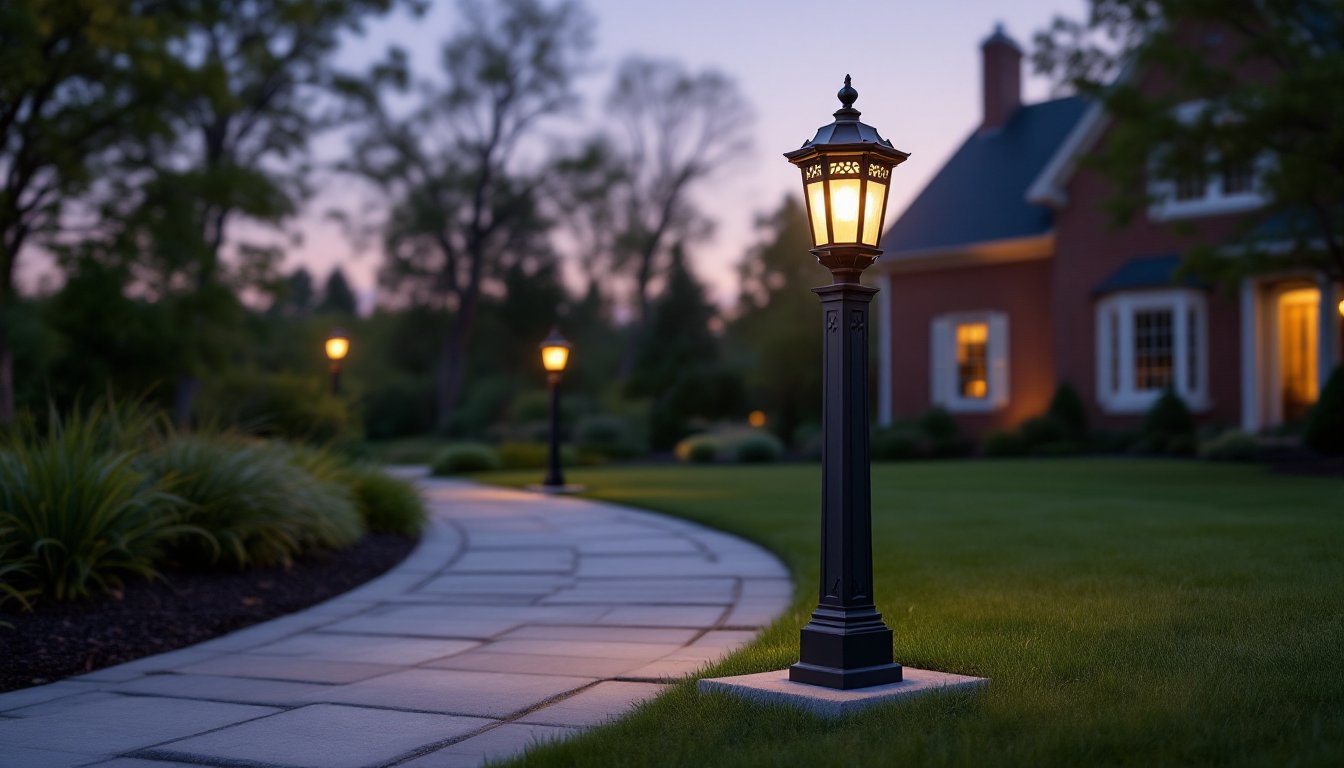
Traditional lamp posts mimic 19th-century gas lanterns, featuring ornate cast-aluminum or wrought-iron posts crowned by multi-pane glass fixtures. Heights range from 6 to 9 feet, and many accept standard E26 medium-base bulbs (incandescent, CFL, or LED). Black, bronze, and verde finishes dominate, though white and brushed nickel options suit Colonial or coastal homes.
These posts work best along curved driveways, brick walkways, or in front of homes with Craftsman, Victorian, or transitional architecture. Expect to pay $150–$600 per post and fixture (material and finish-dependent), plus installation. Because traditional posts rely on line voltage, runs longer than 50 feet from the main panel may require #10 AWG copper to minimize voltage drop, especially if multiple fixtures share a circuit.
One common mistake: mounting a 100-watt-equivalent LED in a small lantern head designed for a 60-watt incandescent. The heat buildup can crack glass panes or degrade gaskets. Always check the fixture’s maximum wattage rating on the UL label.
Modern Bollard Posts
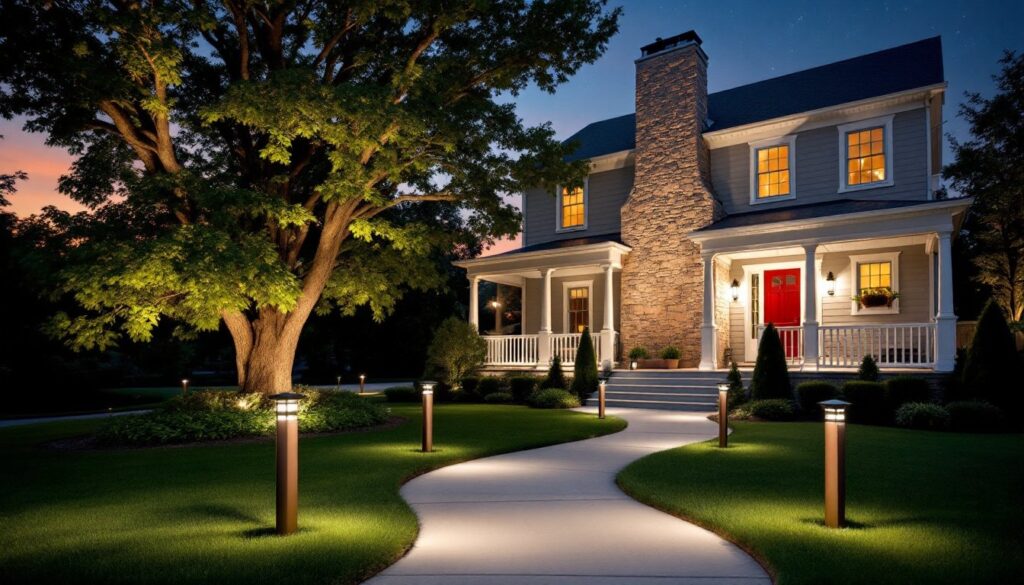
Bollard-style posts are short (typically 24 to 42 inches), cylindrical or square fixtures that direct light downward or outward through frosted acrylic or tempered-glass panels. Powder-coated aluminum and stainless steel are the norm, with matte black, graphite, and brushed-metal finishes. Bollards suit contemporary, mid-century modern, or minimalist landscapes, think gravel courtyards, concrete pavers, or clean-lined hardscapes.
Because bollards sit lower, they create pools of light rather than broad illumination, making them ideal for pathway edging or marking elevation changes. Many models are low-voltage compatible (12V or 24V) and can daisy-chain off a single transformer hidden in a planting bed. A 300-watt transformer can typically handle ten to twelve 3-watt LED bollards on an 80-foot run of 12-gauge landscape wire.
Installation is straightforward if the ground is soft: dig a 12-inch hole, backfill with gravel for drainage, and stake the post. Rocky or clay-heavy soil may require a hammer drill and a pilot hole. For stability, some contractors pour a small concrete collar around the base, though this complicates future relocation.
Solar-Powered Post Lights
Solar post lights integrate a photovoltaic panel (often on top of the fixture or concealed in the cap), a rechargeable battery (usually lithium-ion or NiMH), and an LED array. They range from 3 to 7 feet tall and require zero wiring, making them the fastest install option: stake or bolt to a deck rail and you’re done.
The trade-off is performance. Even premium solar models deliver 50–150 lumens per fixture, roughly one-quarter the output of a wired 6-watt LED bollard. Runtime varies with sunlight exposure: a post shaded by eaves or tree canopy may dim after four hours. Battery life degrades over 2–4 years, and replacement packs aren’t always available for discontinued models.
Solar posts shine (literally) in areas without nearby electrical infrastructure: cottage gardens, remote driveways, or rental properties where permanent wiring isn’t feasible. Popular materials include resin (lightweight, prone to UV fading), aluminum (durable but pricier), and composite (wood-look with better weather resistance). Cost ranges from $40 to $200 per post, with no electrician required.
How to Choose the Right Outdoor Lighting Post for Your Property
Start with height and scale. A 9-foot lamp post dwarfs a single-story ranch, while a 3-foot bollard disappears beside a two-story Colonial. Match post height to the structure it complements: for front-entry posts flanking a walkway, aim for two-thirds the height of the door frame. For driveway or perimeter posts, taller fixtures (7–8 feet) improve visibility from the street and reduce the number of posts needed.
Next, assess light output and distribution. Measure in lumens, not watts. A typical pathway post should deliver 100–200 lumens for ambient lighting: driveways and entries may need 400–800 lumens for security. Check the fixture’s beam angle: narrow spots (20–40°) highlight architectural features, while wide floods (90–120°) wash pathways. Outdoor lighting tips often emphasize layering: combining post lights with low-voltage accent fixtures and wall sconces creates depth without over-lighting.
Material durability matters in coastal or freeze-thaw climates. Powder-coated aluminum resists corrosion better than bare steel, and marine-grade stainless (316 alloy) is the gold standard near saltwater. Wood posts, cedar, redwood, or pressure-treated pine, require annual sealing to prevent rot and insect damage. Vinyl and composite posts skip the maintenance but can look cheap if molding details are shallow.
Finally, confirm electrical compatibility. Line-voltage posts (120V) deliver the brightest, most consistent light but require a GFCI-protected circuit, conduit burial at code-compliant depths (typically 18 inches under walkways, 24 inches under driveways), and often a permit. Low-voltage systems (12V/24V) allow DIY installs with direct-burial cable and waterproof wire nuts, though voltage drop limits run length. Solar posts sidestep wiring but sacrifice brightness and reliability.
Installation Tips: DIY vs. Professional Setup
Low-voltage and solar installations are weekend-warrior territory. For a low-voltage post, mount a weatherproof transformer near an exterior outlet (covered by a GFCI as required by NEC Article 680). Run 12- or 14-gauge landscape wire from the transformer to each post location, burying cable 6 inches deep (check local code). Strip wire ends, connect to the post’s lead wires using silicone-filled wire nuts, and test before backfilling. A post-hole digger and a torpedo level are the only specialty tools required.
Solar posts are even simpler: assemble the fixture per the manufacturer’s instructions, stake or bolt it in place, and position the panel to face south (in the Northern Hemisphere) with minimal shade. No tools beyond a screwdriver and possibly a drill for deck-rail mounts.
Line-voltage posts (120V) cross into permit and licensed-electrician territory in most jurisdictions. Running a new circuit from the main panel, trenching conduit (PVC Schedule 40 or rigid metal), and making weatherproof connections at junction boxes all fall under NEC Article 225 (Outside Branch Circuits and Feeders). Even if local code allows homeowner-installed exterior wiring, mistakes, undersized wire, improper conduit burial depth, missing GFCI protection, create shock and fire hazards. Hiring a pro also ensures the work passes inspection, which protects resale value and homeowners’ insurance claims.
If tackling a line-voltage install even though the warnings, use a trenching guide from experienced DIYers to understand depth requirements and conduit bending techniques. Always call 811 (the national “Call Before You Dig” hotline) 48–72 hours before breaking ground to mark underground utilities.
For post stability, concrete piers beat direct burial in soft or sandy soil. Dig a hole 12 inches in diameter and 30 inches deep (below frost line in cold climates). Insert a 4×4 pressure-treated post or a metal sleeve, plumb it with a level, and pour 60-pound bags of fast-setting concrete mix. Let cure 24 hours before mounting the fixture. In rocky ground, a hammer drill with a 1-inch spade bit and a few bags of pea gravel for backfill can save hours of pickaxe work.
Safety gear: Wear work gloves when handling concrete and wire, safety glasses when drilling or cutting conduit, and rubber-soled boots when working near live circuits. If the project involves digging near mature trees, avoid severing roots thicker than 1 inch: consult an arborist if the path crosses a tree’s drip line. For coastal or high-wind areas, consider hurricane-rated posts or additional guy-wire anchors to prevent toppling.
Finally, maintain realistic expectations. Garden design resources often showcase dramatic lighting schemes that require six to ten posts, and corresponding budgets. A modest front-yard install (two posts flanking a walkway, one at the driveway apron) typically costs $800–$2,000 for materials and professional labor in most markets. DIY solar setups can run as low as $200 for three posts, but the performance gap is real.