Table of Contents
ToggleWrought iron pendant lighting brings a distinctive blend of durability, craftsmanship, and visual weight to any room. Unlike mass-produced stamped metal or plastic fixtures, authentic wrought iron offers hand-forged character that can anchor a design scheme or add contrast to softer finishes. Whether someone’s aiming for industrial edge, farmhouse warmth, or traditional formality, wrought iron pendants deliver a presence that lighter materials simply can’t match. Understanding material properties, installation requirements, and design considerations ensures the fixture performs as well as it looks.
Key Takeaways
- Wrought iron pendant lighting is hand-forged steel with low carbon content, offering durable craftsmanship and visual weight that lighter materials cannot match, with typical 18-inch fixtures weighing 12–20 pounds.
- Standard mounting heights for wrought iron pendants are 30–36 inches above kitchen islands and 30–34 inches above dining tables, with proper spacing of 24–30 inches between pendants to avoid blocking sightlines.
- Oil-rubbed bronze and sealed finishes on wrought iron develop living patinas or prevent oxidation, while LED bulbs (70–80% cooler than incandescent) extend fixture life and prevent heat-related damage.
- Wrought iron pendants require electrical boxes rated for 50+ pounds secured directly to ceiling joists or fitted with fan-rated hardware, not plastic new-work boxes, to safely support the fixture’s weight.
- Pair wrought iron fixtures with natural materials like wood, exposed brick, and stone for farmhouse, transitional, or industrial styles, and mock up sizes with painter’s tape before purchasing to avoid scale mistakes.
- Installation of wrought iron pendant lighting is a moderate-difficulty project requiring attention to wiring, dimmer compatibility with LED bulbs, and local building code compliance, especially in kitchens and bathrooms.
What Makes Wrought Iron Pendant Lighting Special?
Wrought iron is forged steel with very low carbon content, making it malleable enough to shape by hand yet strong enough to support substantial weight. This differs from cast iron, which is brittle and poured into molds. The forging process creates visible hammer marks, scrollwork, and joinery details that give each fixture subtle variations, even in production runs.
Weight is the most immediate consideration. A typical 18-inch wrought iron pendant can weigh 12–20 pounds, sometimes more with glass shades or decorative embellishments. Standard electrical boxes rated for ceiling fans (typically supporting up to 50 pounds when properly anchored to a joist or blocking) handle most pendants, but verifying box capacity before installation prevents failures. If the existing box is a lightweight plastic “new work” style, it needs replacement with a metal pancake box or fan-rated box fastened directly to framing.
Finish durability sets wrought iron apart from powder-coated aluminum or painted steel. Common finishes include matte black, oil-rubbed bronze, aged pewter, and natural rust patinas. Oil-rubbed bronze develops a living finish that darkens with handling and exposure, while sealed rust finishes prevent further oxidation. Unsealed raw iron will continue to patina, which some homeowners prefer for authenticity but requires acceptance of ongoing color shifts.
The material’s thermal mass also affects bulb choice. Wrought iron retains heat, so using LED bulbs (which run 70–80% cooler than incandescent) extends fixture life and prevents finish degradation. If someone prefers the look of Edison-style filament bulbs, LED replicas offer the same aesthetic without the heat penalty.
From a design standpoint, wrought iron reads as substantial and grounded. It pairs well with natural wood, exposed brick, stone, and other materials that have visible texture and weight. This makes it a natural fit for styles popularized in farmhouse decor and rustic interiors, where authenticity and material honesty drive the aesthetic.
Best Rooms and Spaces for Wrought Iron Pendants
Kitchen Islands and Dining Areas
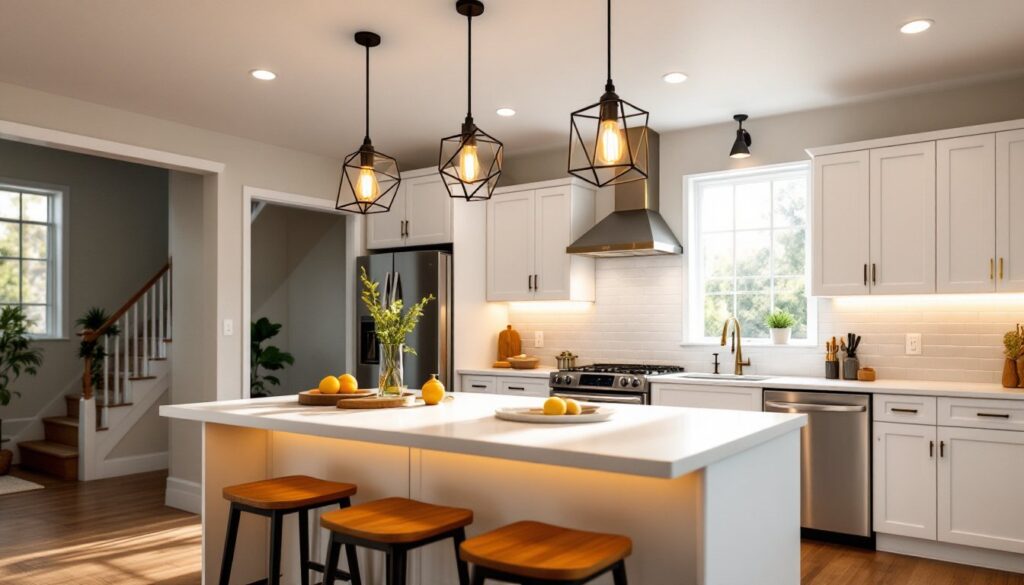
Kitchen islands are the most common application for wrought iron pendants, typically hung in sets of two or three. The standard mounting height is 30–36 inches above the island surface, measured from the bottom of the fixture to the countertop. This range provides task lighting without blocking sightlines across the room.
Spacing matters as much as height. For a single pendant over a small island (4 feet or less), center it. For two pendants over a 6–8 foot island, space them 24–30 inches apart and position them equidistant from the ends, leaving roughly 12–18 inches of clearance on each side. Three pendants over an 8–10 foot island should be spaced evenly with similar end clearances.
Lumens and bulb count depend on whether the pendants serve as task lighting or ambient accent. For task lighting, aim for 450–600 lumens per pendant (roughly equivalent to a 60-watt incandescent). If recessed cans or under-cabinet lighting handle the work light, pendants can run at 300–400 lumens for a softer effect.
Dining tables follow similar height guidelines: 30–34 inches above the table surface for an 8-foot ceiling. Add 3 inches of clearance for every additional foot of ceiling height. The fixture’s diameter should be roughly one-half to two-thirds the table width to maintain visual proportion. A 42-inch round table pairs well with a 20–24 inch pendant, while a 72-inch rectangular table can handle a 30–36 inch fixture or a linear multi-light design.
Entryways, Hallways, and Living Spaces
Entryway pendants need clearance for both sight and passage. The bottom of the fixture should hang 7 feet minimum above the floor in circulation areas, higher if the space sees tall furniture or frequent moves. In two-story foyers, a large statement pendant can hang lower (6.5 feet) if positioned over a console table or centered away from the main traffic path.
Hallways benefit from smaller wrought iron pendants (10–14 inches diameter) spaced 6–8 feet apart. If the hallway is 4 feet wide or less, fixtures should align with the center axis. Wider halls can handle slightly off-center placement to avoid monotony.
Living room pendants work best in defined zones: over a coffee table, in a reading nook, or flanking a fireplace. Avoid centering a single pendant in a large open living space unless the room has a clear focal point like a conversation area or a defined furniture grouping. Wrought iron’s visual weight can make a solo pendant feel awkward in an undefined space.
Outdoor applications, covered porches, breezeways, pergolas, require fixtures rated for wet or damp locations, depending on exposure. Many wrought iron pendants marketed for interior use lack the necessary gaskets and sealed sockets for true wet-location durability. Check the UL rating (Damp or Wet) on the label. Coastal environments accelerate oxidation, so powder-coated finishes or stainless hardware become necessary in salt-air zones.
Choosing the Right Style and Finish
Wrought iron pendants range from minimalist cage designs to ornate chandeliers with scrollwork and glass inserts. Matching style to context prevents clashes and ensures the fixture enhances rather than dominates.
Cage and lantern styles suit modern farmhouse, transitional, and coastal interiors. Simple geometric frames, cubes, cylinders, spheres, offer clean lines that complement Shaker cabinetry, subway tile, and neutral palettes. These styles work well in multiples and don’t compete with patterned backsplashes or busy countertops.
Scrollwork and Gothic details fit traditional, Mediterranean, and Spanish Colonial spaces. Fixtures with curved arms, leaf motifs, and forged rivets echo Old World craftsmanship. These designs pair with heavy timber beams, arched doorways, and terra cotta or natural stone finishes often highlighted in regional home styles.
Industrial and urban loft styles feature exposed hardware, pulley mechanisms, and Edison bulb sockets. Matte black or raw steel finishes lean into the utilitarian aesthetic, pairing well with concrete, reclaimed wood, and metal ductwork. These pendants often have adjustable cord lengths, making them adaptable to varied ceiling heights.
Finish selection affects maintenance and longevity. Oil-rubbed bronze hides fingerprints and minor scratches, developing a richer patina over time. Matte black offers a crisp, graphic look but shows dust more readily, plan on dusting every 1–2 weeks in kitchens where grease and moisture circulate. Aged pewter and antiqued silver finishes split the difference, offering subtle variation without constant upkeep.
Glass or seeded glass shades diffuse light and reduce glare, critical in dining areas where direct downlight can be harsh. Clear glass maximizes light output but exposes the bulb fully, fine for decorative LED filament bulbs, less appealing with standard A19 LEDs. Frosted or alabaster glass softens the glow and hides bulb shapes.
Scale mistakes are common. A 12-inch pendant over a 10-foot island looks lost: a 36-inch fixture over a 48-inch table feels oppressive. When in doubt, mock up the size with cardboard or painter’s tape on the ceiling to visualize proportions before purchasing.
Installation Tips and Considerations
Wrought iron’s weight and the complexity of wiring multi-pendant setups make this a moderate-difficulty project. A confident DIYer can handle a single pendant replacement in an afternoon, but multi-light installations or new circuit work may warrant an electrician.
Safety first: Turn off power at the breaker, not just the switch. Use a non-contact voltage tester to confirm wires are dead before touching anything. Wear safety glasses, ceilings often harbor dust, insulation fibers, and debris that fall during box work.
Inspect the existing electrical box. If it’s plastic or lacks a fan-rated label, it’s not adequate for heavy fixtures. Replace it with a metal ceiling box rated for 50 pounds or more, secured directly to a joist with screws (not just drywall anchors). For retrofit installations where joist access is limited, a fan-rated pancake box or an adjustable bar hanger (like a Westinghouse or Arlington model) spans between joists and provides code-compliant support.
Wiring is straightforward for single pendants: connect black (hot) to black, white (neutral) to white, and bare copper (ground) to the box’s ground screw or green wire. For those exploring modern design approaches with multiple fixtures, multi-light installations require either a single junction box with multiple cord exits (uncommon and tricky to wire) or individual boxes spaced appropriately along the ceiling. Many homeowners opt for a linear canopy that houses a single junction box but distributes pendants along a track or bar, this simplifies wiring and provides adjustable spacing.
Chain length adjustment is simple but tedious. Most pendants ship with excess chain and cord. Determine the desired hanging height, then remove links from the chain using pliers (open the link, slide it off, close the spare link). Shorten the cord by loosening the strain relief inside the canopy, pulling excess wire up, and re-securing. Don’t cut the cord unless absolutely necessary, excess can be coiled inside the canopy.
Dimmer compatibility depends on the bulb type. Standard incandescent dimmers work with incandescent and many dimmable LEDs, but not all LEDs dim smoothly. Look for bulbs labeled “smooth dimming” or “100–10% dimming range.” If the lights flicker or hum at low settings, swap the dimmer for an LED-compatible model (Lutron Diva, Leviton Decora, or similar). Magnetic low-voltage or electronic low-voltage dimmers won’t work with standard screw-base bulbs.
Most jurisdictions don’t require permits for replacing an existing fixture on an existing circuit, but adding a new circuit or relocating a junction box typically does. Check local building codes, especially if the installation affects a kitchen or bathroom covered under stricter electrical requirements (GFCI, AFCI, etc. per NEC).
If the pendant includes glass components, install those after the fixture is mounted. Trying to lift a fully assembled 20-pound pendant with fragile glass shades is a recipe for broken parts. A second pair of hands helps when aligning the canopy to the ceiling box, one person holds the fixture while the other connects wires and fastens mounting screws.
Conclusion
Wrought iron pendant lighting offers lasting quality and visual impact when selected and installed with care. Matching the fixture’s scale, finish, and style to the room’s proportions and design language ensures it enhances rather than overwhelms the space. Proper electrical box support and attention to wiring details prevent future headaches, while thoughtful bulb selection maximizes both light quality and fixture longevity.