Table of Contents
ToggleThe kitchen table is more than a place to eat, it’s where assignments gets finished, game nights happen, and morning coffee turns into conversation. The right lighting makes all that possible without glare, shadows, or fumbling for the dimmer. But walk into any lighting showroom and you’ll face hundreds of fixtures, all claiming to be “perfect for any space.” The truth? Choosing kitchen table lighting comes down to size, placement, and matching the fixture to how the space actually gets used. Get it right, and the table becomes the best-lit spot in the house.
Key Takeaways
- Kitchen table lighting should be sized at one-half to two-thirds the table’s width and hung 30–36 inches above the tabletop to balance effective illumination with comfort and headroom.
- Pendant lights are the most versatile and popular choice for kitchen table lighting, with single pendants suited for small tables and grouped pendants (2–3) providing even coverage over rectangular tables.
- Match metal finishes to your cabinet hardware and faucet, and coordinate fixture style with your kitchen’s design—industrial pendants for farmhouse spaces, classic chandeliers for traditional kitchens, and minimalist drums for modern layouts.
- Install a dimmer switch on your kitchen table light fixture to shift from bright task lighting during meal prep to softer ambiance during dinner without glare or shadows.
- Center the fixture directly over the table’s midpoint (not the room’s center) and leave at least 6 inches of clearance on all sides to prevent visual overflow and ensure comfort for seated diners.
- Check that heavier chandeliers (over 50 lbs) are supported by a ceiling box rated for their weight, and always turn off power at the breaker before installation—hire a licensed electrician if you need to relocate the junction box.
Why Kitchen Table Lighting Matters
A poorly lit kitchen table creates real problems. Overhead recessed lights cast shadows across faces during dinner. A fixture hung too high leaves the table dim while blinding anyone who looks up. Too small, and it disappears visually. Too large, and it dominates the room or becomes a head-bumping hazard.
Task lighting over the table needs to illuminate the entire surface evenly, whether someone’s slicing vegetables for meal prep or kids are working on art projects. Ambient light from ceiling fixtures or natural lighting solutions rarely provides enough focused coverage.
Beyond function, the fixture anchors the dining area visually. In open-concept kitchens, it defines the eating zone and adds a focal point that pulls the eye. The style, finish, and scale of the light set the tone, industrial pendants signal casual, while a chandelier leans formal.
Dimming capability matters too. Install a dimmer switch on any kitchen table fixture to shift from bright task lighting during meal prep to softer ambiance during dinner. Most LED-compatible dimmers work with standard incandescent and LED bulbs, but check compatibility to avoid flickering.
Types of Kitchen Table Lighting Fixtures
Pendant Lights
Pendant lights hang from the ceiling on a cord, chain, or rod, delivering focused light directly over the table. They’re the most common choice for kitchen tables because they’re versatile, available in thousands of styles, and easy to install.
Single large pendants work over small round or square tables (36″ to 48″ diameter). For rectangular tables, groupings of two or three pendants provide even coverage and visual balance. Space multiple pendants 24″ to 30″ apart, centered over the table length.
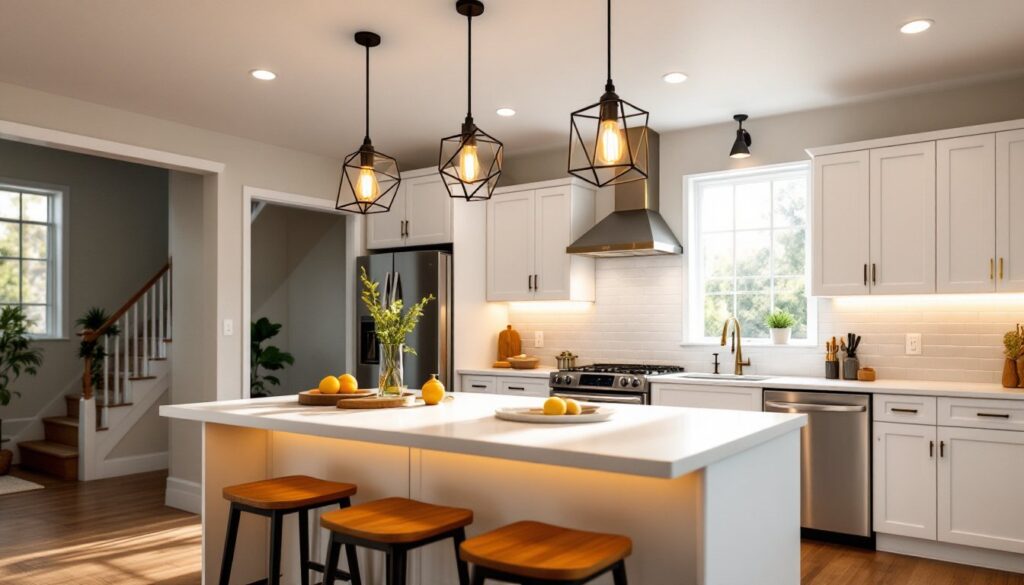
Pendant styles range widely. Glass globe pendants offer diffused light and a clean look. Metal drum or cage pendants add industrial or farmhouse character. Mini pendants (8″ to 12″ diameter) suit smaller tables or layered lighting schemes. For design inspiration across various fixture types, kitchen pendant collections often showcase how different shapes and finishes change a space’s feel.
Most pendants use medium-base (E26) sockets and work with standard bulbs. Check the maximum wattage rating, usually 60W to 100W for incandescent equivalent. LED bulbs provide better efficiency and last 15,000+ hours.
Chandeliers
Chandeliers deliver more presence and formality than pendants. They work best over larger tables (60″ or longer) in dining rooms or eat-in kitchens with traditional or transitional decor.
Candelabra-style chandeliers use multiple arms with smaller bulbs (often candelabra base E12 sockets). Linear chandeliers, rectangular fixtures with multiple light sources, suit long farmhouse tables and modern spaces. Drum chandeliers combine the chandelier’s multi-bulb setup with a fabric or metal shade for diffused light.
Chandeliers typically require a ceiling junction box rated for fixtures over 50 lbs. Standard boxes support up to 50 lbs, but heavier fixtures need a fan-rated or heavy-duty box anchored to a ceiling joist. If you’re unsure whether your box is rated correctly, hire an electrician, improper support is a safety hazard.
Dimming a chandelier creates flexibility. Pair it with a compatible dimmer and dimmable bulbs (check LED bulb packaging for “dimmable” labeling). Comparing different lighting styles helps narrow choices when deciding between traditional crystal, rustic wood and metal, or sleek modern designs.
How to Size Your Kitchen Table Light Fixture
Fixture size directly affects both function and aesthetics. Too small and it looks lost: too large and it overwhelms the space or restricts movement.
General sizing rule: The fixture diameter (or width for linear fixtures) should be one-half to two-thirds the width of the table. For a 36″ wide table, choose a fixture 18″ to 24″ in diameter. For a 42″ table, aim for 21″ to 28″.
Rectangular tables pair well with linear fixtures or a row of pendants. A 72″ long table works with a linear chandelier or pendant grouping that’s roughly 30″ to 40″ long. Multiple pendants should span about half the table’s length when grouped.
Measure carefully before buying. A 60″ round table needs a fixture around 30″ to 40″ in diameter, a 12″ mini pendant will disappear visually, while a 50″ chandelier crowds the space.
In rooms with particularly high ceilings or open layouts, scale affects how the light interacts with the broader space. Those tackling high ceiling lighting challenges often need larger fixtures to maintain proportion.
Clearance matters too. Leave at least 6 inches of clearance on all sides between the fixture’s edge and the table’s edge. This prevents the fixture from visually spilling over and ensures anyone sitting at the table isn’t hit by the fixture’s edge when they lean back.
If the table sits in a small eat-in kitchen (under 100 square feet), consider slightly undersizing the fixture to avoid a cramped feel. Function still comes first, ensure the light covers the table adequately even if you size down for aesthetics.
Optimal Placement and Height for Kitchen Table Lighting
Hang the fixture 30″ to 36″ above the tabletop. This is the industry-standard range that balances effective illumination with headroom. At 30″, the light floods the table surface with minimal glare. At 36″, it allows taller individuals to sit comfortably without the fixture in their sightline.
For tables in rooms with ceilings higher than 8 feet, add 3″ of chain or cord length for every additional foot of ceiling height. A 10-foot ceiling calls for hanging the fixture around 36″ to 42″ above the table.
Measure from the bottom of the fixture to the table surface, not from the ceiling. Use a tape measure and a helper to mock up the height with the fixture’s actual dimensions before final installation.
Centering is critical. The fixture should hang directly over the table’s center point, not the room’s center. In open kitchens, the table may not be centered in the space, so measure and mark the table’s midpoint before installing the electrical box.
If the existing junction box isn’t in the right spot, it will need to be moved. This involves cutting into drywall, running new wire, patching, and painting. That’s a job for a licensed electrician unless you’re comfortable working with household wiring and local codes. Most jurisdictions require electrical work to meet NEC (National Electrical Code) standards, and moving a box usually requires a permit.
Multiple pendants should be evenly spaced along the table’s length. For three pendants over a 72″ table, space them roughly 24″ apart. Mark each location carefully and ensure all three hang at identical heights, uneven pendants look sloppy.
Always turn off power at the breaker before installing or adjusting any light fixture. Use a non-contact voltage tester to confirm the circuit is dead before touching any wires.
Choosing the Right Style and Finish
Style and finish tie the fixture into the kitchen’s overall design. Mismatched finishes create visual clutter: coordinated choices feel intentional.
Match metal finishes to cabinet hardware, faucet, and appliance finishes when possible. Brushed nickel, oil-rubbed bronze, matte black, and brass are the most common. Mixing metals works, say, black pendants with brass hardware, but keep it to two or three finishes max across the room.
Style should complement cabinetry and architecture. Shaker cabinets and farmhouse sinks pair well with industrial-style metal pendants or rustic wood-and-metal chandeliers. Sleek flat-panel cabinets call for minimalist drum pendants or geometric fixtures. Traditional raised-panel cabinets suit classic chandeliers with candelabra bulbs.
Glass shades, clear, frosted, or seeded, work in nearly any style and provide excellent light diffusion. Clear glass shows the bulb, so use decorative Edison-style or vintage filament LEDs for a finished look. Frosted or opal glass hides the bulb and reduces glare.
Think about how the fixture reads from other parts of the home. In open-concept layouts, the kitchen table light is visible from the living room and entryway. It should feel cohesive with lighting in those adjacent spaces without being identical. For example, similar finishes across rooms maintain flow even if fixture shapes differ.
Black fixtures have surged in popularity and suit modern farmhouse, industrial, and contemporary kitchens. Warm brass and aged brass finishes bring richness to traditional and transitional spaces. When exploring fixture styles broadly, notice how finish choice shifts a fixture’s formality and warmth.
Consider how the finish will age. Oil-rubbed bronze develops a patina over time. Polished chrome shows fingerprints and water spots easily. Matte black hides smudges but can look flat in dim light without contrasting details.
Shade material affects both light quality and style. Metal shades (often in pendants) direct light downward and create focused pools of light, great for task lighting but less effective for ambient glow. Fabric drum shades diffuse light widely and soften the overall feel, though they’re less common directly over tables due to cleaning challenges (grease, splatters). If you’re layering lighting and want additional warmth elsewhere in the kitchen, ideas for creating cozy ambiance can complement the table’s primary fixture.