Table of Contents
ToggleGetting the lighting right in a dining room isn’t just about screwing in a bulb and calling it done. The fixture hanging over your table sets the entire mood for family dinners, holiday gatherings, and everything in between. Too bright, and you’re eating under interrogation-level glare. Too dim, and your guests are squinting at their plates. The good news? Choosing the right dining room fixture is straightforward once you know what to look for. This guide walks through fixture types, sizing formulas, bulb selection, and installation height, everything needed to light your dining space properly.
Key Takeaways
- Lighting fixtures for dining rooms serve dual purposes—providing task lighting for eating and creating ambient lighting that sets the room’s mood, making fixture selection critical for both function and aesthetics.
- Choose warm-toned bulbs in the 2700K–3000K color temperature range to make food appear appetizing; cooler daylight bulbs create an institutional look that diminishes the dining experience.
- Size your fixture using the formula: table width in feet minus 12 inches equals maximum fixture diameter—a 42-inch table needs a fixture no wider than 30 inches to avoid visual imbalance.
- Install the bottom of the fixture 30–36 inches above the table surface; higher ceilings (9+ feet) allow fixtures to hang slightly lower, while standard 8-foot ceilings benefit from the 30–32 inch range.
- Select LED bulbs rated for your fixture type with a Color Rendering Index (CRI) of 90 or higher to ensure accurate food colors and long-term energy savings of 75–80% compared to incandescent bulbs.
- Use a compatible LED dimmer switch during installation to avoid flickering and buzzing, and verify your ceiling box is rated for the fixture weight—standard boxes support up to 50 pounds.
Why Dining Room Lighting Matters More Than You Think
The dining room fixture does double duty that most lights don’t. First, it provides task lighting, enough brightness to see what you’re cutting, serving, and eating. Second, it creates ambient lighting that defines the room’s character. A well-chosen fixture makes the space feel intentional, while the wrong one screams “builder-grade afterthought.”
Lighting also affects how food looks. Warm-toned bulbs (2700K-3000K) make meals appear appetizing, while cooler daylight bulbs can give everything a washed-out, cafeteria vibe. Nobody wants their pot roast looking institutional.
Beyond aesthetics, the fixture height and spread determine whether your table is evenly lit. A fixture that’s too small leaves the edges of the table in shadow. One that’s too large overwhelms the space and can obstruct sightlines across the table. Getting these proportions right is critical, and there’s a formula for it (covered in the sizing section below).
Finally, many luxury fixtures include dimmer compatibility, which lets homeowners shift from bright task lighting during meal prep to softer ambiance during dinner. Dimming capability should be part of the planning phase, not an afterthought.
Popular Types of Dining Room Lighting Fixtures
Choosing a fixture type comes down to ceiling height, table shape, and the overall design style of the room. Here are the two most common options that work for the majority of dining setups.
Chandeliers: The Classic Centerpiece
Chandeliers remain the go-to choice for dining rooms with standard 8- to 10-foot ceilings. They provide 360-degree light distribution and serve as a visual anchor for the room. Traditional chandeliers feature multiple arms with candelabra-style bulbs (often E12 bases), while modern interpretations use geometric frames, drum shades, or Edison-style exposed bulbs.
When selecting a chandelier, pay attention to the fixture’s canopy diameter and overall drop length. Most chandeliers hang from a down rod (a metal tube that extends from the ceiling junction box to the fixture body). Down rods are available in 6-inch increments, and swapping them out is straightforward if the fixture hangs too low or too high after installation.
For traditional or farmhouse styles, designers at Elle Decor frequently showcase wrought iron or distressed wood chandeliers with Edison bulbs. For contemporary spaces, look for chandeliers with clean lines, matte black or brushed nickel finishes, and integrated LED arrays.
One practical note: chandeliers with upward-facing sockets (candelabra arms pointing up) collect dust inside the shades. If low maintenance is a priority, choose downward-facing or enclosed designs.
Pendant Lights: Modern Versatility
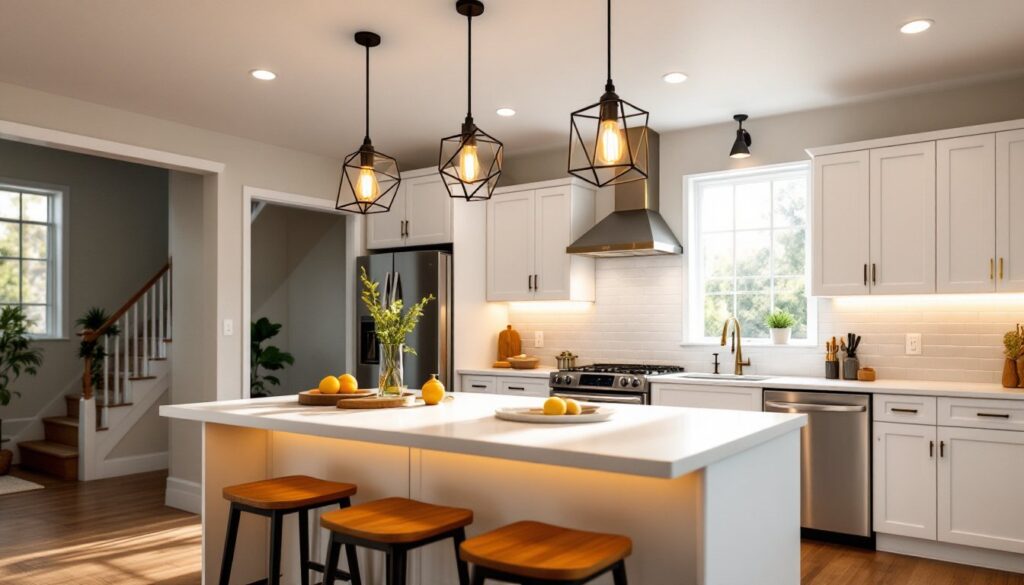
Pendant lights are single fixtures that hang from the ceiling on a cord, chain, or rod. They work especially well over narrow or rectangular tables, where a single large chandelier might look off-balance. Many homeowners install two or three pendants in a row to provide even coverage across the table length.
Pendants come in countless shapes: globe, drum, cone, cage, lantern, and more. Mini pendants (under 12 inches in diameter) are ideal for groupings, while large statement pendants (18–24 inches) can stand alone over round or square tables.
Installation flexibility is a key advantage. Most pendants use adjustable cord or chain, making it easier to dial in the perfect height compared to fixed-length chandeliers. But, pendant cords can look cluttered if not managed carefully, consider cord covers or swag hooks if the junction box isn’t centered over the table.
For those interested in different fixture styles, pendants offer the widest range. Industrial-style metal cages, hand-blown glass globes, woven rattan shades, and minimalist concrete designs all fall under the pendant umbrella. Pair pendants with dimmer switches to maximize their versatility.
How to Choose the Right Size Fixture for Your Dining Table
Guessing fixture size leads to awkward proportions. Use these formulas to get it right the first time.
For chandeliers and single large pendants:
- Measure the table width (in feet) and subtract 12 inches. The result is the maximum fixture diameter.
- Example: A 42-inch-wide table (3.5 feet) should have a fixture no wider than 30 inches.
This ensures the fixture doesn’t overhang the table edge, which creates a visual imbalance and increases the risk of someone bumping their head when standing up.
For groupings of multiple pendants:
- Space pendants 24 to 30 inches apart, measured from center to center.
- Leave at least 6 inches of clearance between the outermost pendant and the table edge.
- For a 72-inch (6-foot) rectangular table, three 10-inch pendants spaced 28 inches apart works well.
Room size also matters. A common rule of thumb is to add the room’s length and width (in feet), then convert that sum to inches to find an appropriate fixture diameter. For a 12-foot by 14-foot dining room, that’s 12 + 14 = 26, suggesting a fixture around 26 inches in diameter. This formula works best in rooms where the table is proportional to the space.
If the dining area is part of an open floor plan, base sizing on the table dimensions rather than the entire room. Otherwise, the fixture will look oversized and dominate the kitchen or living area visually.
For those tackling installation in spaces with high ceilings, longer down rods or adjustable pendants prevent the fixture from appearing lost in the vertical space. Ceilings above 10 feet often require custom rod lengths or tiered chandeliers that fill the visual gap.
Selecting the Best Light Bulbs and Color Temperature
The fixture is only half the equation. Bulb choice determines the quality, color, and energy cost of the light.
Bulb type:
- LED bulbs are the standard for dining rooms. They use 75–80% less energy than incandescent bulbs, last 15,000–50,000 hours, and produce minimal heat.
- Look for bulbs rated for enclosed fixtures if the chandelier or pendant has glass shades. Not all LEDs dissipate heat well in enclosed spaces, and using the wrong type shortens bulb life.
- Avoid CFLs (compact fluorescents). They take time to warm up, contain mercury, and don’t dim smoothly.
Color temperature (measured in Kelvin):
- 2700K (soft white): Warm, yellowish light. Best for traditional and cozy dining rooms. Mimics incandescent bulbs.
- 3000K (warm white): Neutral warm tone. Works well in transitional and modern farmhouse styles.
- 4000K and above (cool white/daylight): Too clinical for dining spaces. Save these for garages and task areas.
Stick to 2700K–3000K for dining rooms. Anything cooler makes the space feel institutional.
Lumens (brightness):
- Dining rooms need 3,000–6,000 lumens total, depending on room size.
- For a fixture with five bulbs, that’s 600–1,200 lumens per bulb.
- If installing dimmable lights, choose bulbs rated for dimming. Not all LEDs dim smoothly, cheap ones flicker or cut out at low settings.
CRI (Color Rendering Index):
- CRI measures how accurately colors appear under a light source, on a scale of 0–100.
- Choose bulbs with a CRI of 90 or higher for dining rooms. Lower CRI makes food and decor look dull.
- Most quality LED bulbs list CRI on the packaging.
Bulb base size:
- E26 (medium base): Standard in most chandeliers and pendants.
- E12 (candelabra base): Common in traditional chandeliers with decorative candle-shaped bulbs.
- Verify the base size before buying bulbs. An E26 bulb won’t fit an E12 socket.
Finally, if using decorative Edison-style bulbs, note that many produce warmer tones (2200K–2400K) and lower lumens. They look great but may not provide enough task lighting on their own. Consider pairing them with a dimmer or supplemental ambient lighting elsewhere in the room.
Installation Tips and Height Guidelines for Dining Room Fixtures
Proper installation height makes or breaks a dining room fixture. Too low, and it’s a head hazard. Too high, and the light diffuses too much before reaching the table.
Standard height guideline:
- Hang the bottom of the fixture 30–36 inches above the table surface.
- For 8-foot ceilings, aim for the lower end (30–32 inches) to keep the fixture from feeling cramped.
- For ceilings 9 feet or higher, go toward 36 inches or slightly more.
Measuring correctly:
- Measure from the tabletop to the fixture’s lowest point, not from the floor. Table heights vary (standard dining tables are 28–30 inches tall), so floor-to-fixture measurements can be misleading.
Electrical box location:
- Most dining rooms have a ceiling junction box centered in the room, but not always centered over the table (especially in older homes or open floor plans).
- If the box is off-center by a few inches, a ceiling canopy (the decorative cover that mounts to the box) can sometimes hide minor offsets. For larger gaps, consider hiring an electrician to relocate the box. This is structural work that may require a permit, depending on local codes.
- Alternatively, use a swag hook to offset a pendant, though this only works if you’re okay with exposed cord running at an angle.
Dimmer installation:
- Install a compatible LED dimmer switch at the same time as the fixture. Standard rotary dimmers designed for incandescent bulbs cause LED flickering and buzzing.
- Lutron and Leviton both make reliable LED dimmers. Match the dimmer’s wattage rating to the total wattage of all bulbs in the fixture.
DIY vs. hiring out:
- Swapping a fixture (replacing an existing one on the same junction box) is a straightforward DIY job for anyone comfortable working with electrical wiring. Turn off the breaker, confirm power is off with a non-contact voltage tester, and follow the fixture’s instructions.
- Wear safety glasses when working overhead. Dust, old insulation, and debris often fall when removing old fixtures.
- If installing a new junction box, running new wire, or working in a room with no existing fixture, hire a licensed electrician. This work must meet National Electrical Code (NEC) standards, and most jurisdictions require a permit.
Weight considerations:
- Standard ceiling boxes rated for lighting support up to 50 pounds.
- Heavy chandeliers (over 50 pounds) require a fan-rated box or a box with additional bracing attached to a ceiling joist.
- If unsure about your box’s rating, check the markings on the box itself or consult an electrician. An undersized box is a safety hazard.
For those exploring other fixture types in adjacent rooms, the same height and box-rating principles apply, just adjust spacing and lumens based on room function.
Finally, test the fixture at full brightness and at the lowest dim setting before putting tools away. Confirm there’s no flickering, buzzing, or dead bulbs. Addressing issues immediately is easier than climbing back up the ladder a week later.