Table of Contents
TogglePendant lights aren’t just for dining rooms and kitchens anymore. Homeowners are discovering that a well-placed pendant can transform a living room from flat and uninspired to layered and intentional. Unlike recessed cans that disappear into the ceiling or bulky floor lamps that eat up square footage, pendants offer focused task lighting, sculptural interest, and a chance to define zones in open-plan spaces. Whether someone’s reading in a corner chair, highlighting a coffee table, or adding drama over a console, the right pendant brings both function and style, without the footprint of traditional fixtures.
Key Takeaways
- Living room pendant lighting provides focused task lighting and sculptural interest while freeing up floor and surface space that traditional lamps consume.
- Size your pendant to be one-quarter to one-third the width of the furniture it covers, and hang it 28–34 inches above tables to ensure optimal light without blocking sightlines.
- Modern pendants work well in multiples with consistent cord heights, while traditional styles pair best with dimmer switches and benefit from layered ambient, task, and accent lighting.
- Proper installation requires a secure junction box, correct wire color matching, and at least 6.5 feet of clearance from floor to fixture in walkways to prevent head-bumping hazards.
- In open-concept homes, pendant lights visually define zones and separate conversation areas without walls, making them ideal spatial dividers in modern floor plans.
Why Pendant Lights Are Perfect for Living Rooms
Pendants excel where other fixtures fall short. They deliver downward-focused illumination without the harsh, clinical feel of overhead fluorescents or the scattered glow of table lamps. This makes them ideal for task zones, reading nooks, side tables, or game areas, where precise light matters.
In open-concept homes, pendants act as spatial dividers. Hanging a cluster over a seating area signals “this is the conversation zone,” while the rest of the room flows into dining or kitchen space. It’s a visual cue that doesn’t require walls or rugs.
Pendants also free up floor and surface real estate. Unlike tripod lamps or chunky torchieres, a ceiling-mounted fixture keeps corners clear and tabletops uncluttered. For small living rooms or spaces with awkward layouts, that vertical real estate is gold.
Finally, pendants offer design flexibility. Swap a globe for a drum shade or a cage-style industrial piece, and the entire room’s character shifts. Experienced designers often incorporate ambient and task lighting to build layered schemes that adapt to different activities and moods. Pendant lights slot neatly into that strategy, providing the sculptural centerpiece that recessed cans can’t deliver.
Choosing the Right Pendant Light Style for Your Space
Modern and Minimalist Pendant Designs
Modern pendants strip away ornamentation in favor of clean lines, geometric forms, and industrial materials. Expect brushed nickel, matte black, or powder-coated steel housings paired with exposed Edison bulbs or integrated LED arrays. Globe pendants, single spheres of opal glass or smoked acrylic, are workhorses in this category. They diffuse light evenly without glare and suit mid-century or Scandinavian interiors.
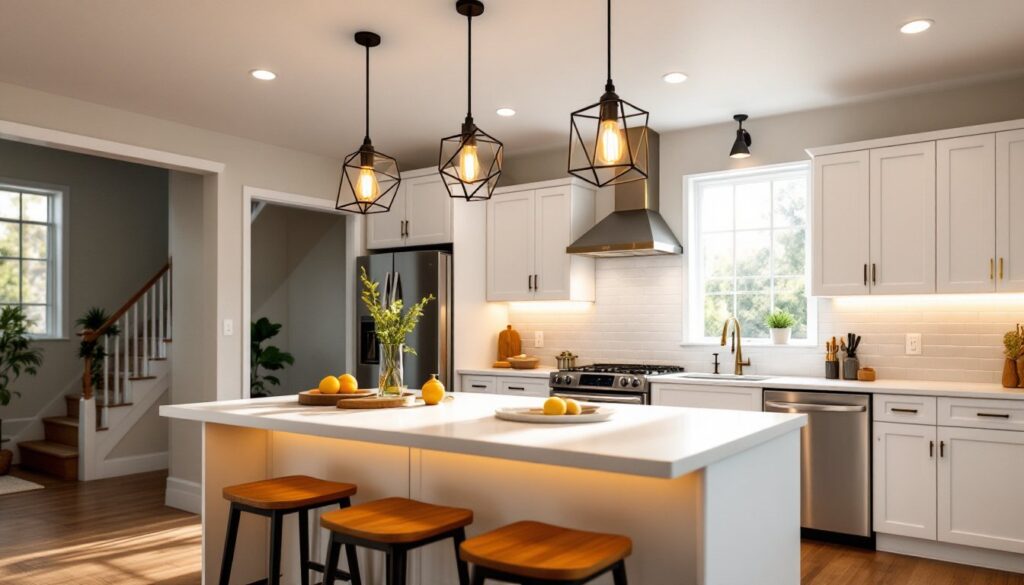
Cage-style pendants, featuring wire frames around a bare bulb, lean industrial. They work well in lofts, exposed-brick spaces, or rooms with concrete or metal accents. For a softer take, consider drum shades in linen or canvas: they maintain the minimalist silhouette but add textile warmth.
Placement matters. Modern pendants often hang in multiples, three small globes over a console or a pair flanking a sectional. Keep the cords at consistent heights unless asymmetry is intentional. In rooms with 8-foot ceilings, low-profile designs (under 12 inches in total drop) prevent head-bumping and visual clutter. Browse inspiration galleries like these living room pendant examples to see how scale and repetition work in real spaces.
Traditional and Transitional Options
Traditional pendants lean on classic materials: aged brass, oil-rubbed bronze, frosted glass, and fabric shades. Lantern-style fixtures with beveled panels suit colonial or farmhouse interiors, while bell-shaped glass shades fit Victorian or cottage aesthetics. These designs often feature decorative details, finials, scrollwork, or beaded trim, that tie into crown molding, wainscoting, or paneled doors.
Transitional pendants split the difference. They borrow traditional forms, cylindrical shades, tapered silhouettes, but simplify the details and swap heavy finishes for neutrals like brushed champagne or satin nickel. A linen drum shade with a simple metal band reads transitional: add beaded fringe or tassels, and it tips traditional.
Pair traditional pendants with dimmer switches rated for the bulb type (incandescent, LED, or CFL). Many decorative fixtures use candelabra-base (E12) bulbs, which come in lower wattages than standard medium-base (E26) bulbs. Plan for 100–150 watts equivalent per pendant if it’s the primary light source, or 40–60 watts if it’s supplemental. Experts in lighting design often recommend layering ambient, task, and accent sources to avoid over-reliance on a single fixture.
How to Size and Position Your Pendant Lights
Getting the proportions wrong is the fastest way to make a pendant look like an afterthought. For single pendants, the fixture diameter should be roughly one-quarter to one-third the width of the surface it’s centered over. A 48-inch console calls for a 12- to 16-inch pendant: a 72-inch sectional can handle 18–24 inches.
When hanging multiples, treat them as a single visual unit. Three 8-inch globes spaced 18 inches apart create an effective 42-inch “fixture” (3 × 8 + 2 × 9). That combined width should still follow the one-quarter to one-third guideline relative to the furniture below.
Height depends on ceiling clearance and foot traffic. Over a coffee table or side table, the bottom of the shade should hang 28 to 34 inches above the surface, low enough to cast useful light, high enough to avoid blocking sightlines. In walkways or open floor areas, maintain at least 6.5 feet of clearance from the floor to the fixture’s lowest point. Taller household members will appreciate the extra inch or two.
For rooms with vaulted or cathedral ceilings, pendants become even more critical. Standard recessed cans disappear into the height, leaving the lower living zone dim. A pendant with an adjustable rod or cord can drop into the usable light range while adding vertical interest. Just avoid letting the fixture hang so low it competes with furniture or creates a visual “hole” in the middle of the room. Homeowners tackling high-ceiling lighting challenges often use pendants to bridge the vertical gap between ceiling and living space.
Finally, consider the cord or rod length during purchase. Most pendants ship with 6 to 10 feet of cord, which can be shortened by looping excess inside the canopy or trimming (if the fixture allows). Rigid-rod pendants typically come in 6-, 12-, or 24-inch sections. Measure ceiling height and desired drop before ordering to avoid returns or expensive custom rods.
Installing Living Room Pendant Lighting: A Step-by-Step Guide
Safety first: Turn off power at the breaker, not just the wall switch. Use a non-contact voltage tester to confirm the circuit is dead before touching any wires. Wear safety goggles and work gloves, especially when handling metal junction boxes or sharp fixture edges.
Tools and materials:
- Non-contact voltage tester
- Wire stripper/cutter
- Needle-nose pliers
- Screwdriver (flathead and Phillips)
- Adjustable wrench (for threaded rods)
- Ladder rated for the installer’s weight
- Wire nuts (usually included with fixture)
- Electrical tape
- Junction box rated for fixture weight (most pendants under 50 lbs use a standard 4-inch box: heavier fixtures require a fan-rated box)
Step-by-step installation:
-
Confirm the junction box is properly secured. If the existing box is nailed to a single joist or attached with flimsy clips, replace it with a fan-rated pancake box anchored to blocking between joists. Pendant lights exert lateral pull on the mounting hardware, and a loose box will sag over time.
-
Thread the fixture wires through the canopy and mounting hardware. Most pendants use a threaded nipple (a short metal tube) that screws into the junction box. Slide the canopy, locknut, and any decorative collars onto the cord or rod before wiring, forgetting this step means disassembly later.
-
Match wire colors and make connections. Pendants typically have a black (hot), white (neutral), and green or bare (ground) wire. Connect black to black, white to white, and ground to ground (or to the green screw on the mounting bracket). Twist wires clockwise with pliers, then screw on a wire nut. Tug each connection to verify it’s secure. Wrap the base of the wire nut with electrical tape for extra insurance.
-
Adjust cord or rod length. For cord pendants, pull excess slack through the canopy and loop it inside the junction box. Some canopies include a cord lock or clamp: tighten it once the desired drop is set. For rod pendants, thread the rod sections together hand-tight, then snug with an adjustable wrench. Don’t overtighten, you’ll strip the threads.
-
Attach the canopy to the junction box. Align the mounting bracket’s screw holes with the box’s threaded ears. Drive screws until snug, but don’t crank them: overtightening can crack plastic canopies. If the canopy doesn’t sit flush, the threaded nipple may be too long, remove a section or use a shorter nipple.
-
Install the bulb(s) and shade. Match the bulb base type (E26 medium or E12 candelabra) and don’t exceed the fixture’s maximum wattage rating (stamped on the socket or listed in the instructions). LED bulbs run cooler and last longer than incandescent, and they’re compatible with most dimmer switches if the dimmer is LED-rated. Attach the shade according to the manufacturer’s design, some screw onto a threaded ring (finial), others clip or slide into place.
-
Restore power and test. Flip the breaker, then the wall switch. If the light doesn’t turn on, shut off power again and recheck wire connections. A loose neutral is the most common culprit. If the bulb flickers, the issue may be an incompatible dimmer or a poor connection at the switch.
Permit and code considerations: Replacing an existing fixture on the same circuit typically doesn’t require a permit, but adding a new circuit or relocating a junction box does. The National Electrical Code (NEC) requires all metal parts to be grounded and junction boxes to remain accessible (no drywall over them). Local codes vary, so check with the municipality before running new wire or cutting into ceilings.
If the living room lacks a ceiling box, installing one means cutting drywall, running cable from a nearby switch or outlet, and patching. That’s a two-person, half-day job, or a good reason to call a licensed electrician. For renters or commitment-phobes, plug-in swag pendants offer a workaround: they hang from a ceiling hook and plug into a wall outlet. No wiring required, though the draped cord won’t suit every aesthetic. Rooms with complex lighting configurations may benefit from professional layout planning to ensure even coverage and code compliance.
Conclusion
Pendant lights punch above their weight in living rooms, adding task lighting, visual interest, and spatial definition without the bulk of floor lamps or the anonymity of recessed cans. Choose a style that complements the room’s architecture, size it to the furniture below, and install it with attention to wire connections and code requirements. Done right, a pendant becomes the functional centerpiece the space didn’t know it needed.