Table of Contents
ToggleLuxury isn’t just about price tags, it’s about intention. In a living room, lighting does more heavy lifting than any single design element. It defines mood, highlights architecture, and turns a plain box into a space worth spending time in. The difference between a room that feels expensive and one that just looks it often comes down to how light moves through the space. By 2026, homeowners are ditching the single-ceiling-fixture approach and embracing layered, controllable systems that work as hard as they look good. This guide breaks down the strategies, fixtures, and tech that separate luxury living room lighting from the average setup.
Key Takeaways
- Luxury living room lighting relies on layered, multi-source systems rather than single-fixture approaches, using ambient, task, and accent lighting at different heights and intensities.
- High-end bulbs should have a CRI of 90+ and color temperature between 2700K–3000K (warm white) to render colors and textures accurately, making fabrics and artwork appear their best.
- Statement fixtures like geometric chandeliers, pendant clusters, and linear suspensions anchor luxury living rooms visually and should be sized proportionally to room dimensions and ceiling height.
- Smart dimmer controls and scene programming transform good lighting into great lighting by enabling precise mood adjustment, with dimmers required on all circuits for LED compatibility.
- Accent lighting should be at least three times brighter than ambient light to effectively highlight architectural features like textured walls or artwork without appearing harsh.
Why Lighting Is the Foundation of Luxury Living Room Design
Walk into any high-end hotel lobby or designer showroom, and you’ll notice the lighting before you notice the furniture. That’s not an accident. Lighting establishes spatial hierarchy, it tells your eye where to look, how to feel, and what matters in the room.
In residential living rooms, poor lighting reveals itself in two ways: either everything’s too bright (the overhead flood effect), or it’s too dim and cave-like. Luxury design avoids both extremes by using multiple light sources at different heights and intensities. This creates depth, dimension, and visual interest that a single ceiling fixture can’t deliver.
Another critical factor: color temperature and CRI (Color Rendering Index). Cheap LEDs with a CRI below 80 make fabrics, artwork, and skin tones look washed out. For a living room, aim for bulbs rated CRI 90+ and a color temperature between 2700K and 3000K (warm white). This mimics the quality of incandescent light without the energy waste.
Finally, luxury lighting adapts. It doesn’t force you into one mood. Designers using dimmable controls allow homeowners to shift from bright task lighting during the day to soft, ambient warmth in the evening. If your living room lighting can’t be adjusted, it’s not flexible enough for real luxury.
Layering Light: The Three Essential Types for Luxury Spaces
Ambient Lighting: Setting the Mood
Ambient lighting is the foundation, it fills the room with general illumination. In luxury living rooms, this rarely comes from a single source. Instead, designers combine recessed cans, cove lighting, or large pendants to create even, shadow-free coverage.
For rooms with standard 8- to 9-foot ceilings, 4-inch or 6-inch recessed downlights spaced roughly 4 to 6 feet apart provide clean, unobtrusive ambient light. In spaces with higher ceilings, consider solutions designed for vertical reach to avoid dark pockets near the floor.
Cove lighting, LEDs hidden behind crown molding or in ceiling trays, adds a soft, indirect glow that feels sophisticated without glare. Pair it with a dimmer, and you’ve got instant control over the room’s intensity.
Task Lighting: Function Meets Elegance
Task lighting targets specific activities: reading, working on a laptop, or examining artwork. In luxury living rooms, this means floor lamps, table lamps, and picture lights placed where they’re actually needed.
Look for adjustable-arm floor lamps with three-way switches or integrated dimmers. Brands like Artemide and Flos offer designs that blend form and function, but mid-tier options from WAC Lighting or Adesso work well if you prioritize adjustability and build quality.
For reading zones, aim for 40 to 60 watts equivalent LED output (around 450 to 800 lumens) positioned 15 to 20 inches from the reading surface. Too far, and you’re squinting: too close, and you get harsh shadows.
Don’t overlook picture lights for showcasing art. Battery-operated LED picture lights have come a long way, but hardwired options still deliver better color accuracy and consistent output.
Accent Lighting: Highlighting Architectural Features
Accent lighting is where luxury living rooms show personality. It’s not about illuminating, it’s about emphasizing. Use uplights, wall sconces, and track lighting to draw attention to textures, materials, and architectural details.
Wall washers, fixtures that cast light evenly across a vertical surface, make textured stone, wood paneling, or gallery walls pop. Install them 12 to 18 inches from the wall for the best effect.
Track systems offer flexibility if your living room layout changes frequently. Modern low-voltage track lighting options let you reposition heads without rewiring, and many now accept interchangeable lenses for different beam spreads.
One rule: accent lighting should be at least three times brighter than ambient lighting in the area you’re highlighting. Any less, and the effect gets lost. Any more, and it feels like a spotlight at an interrogation.
Statement Fixtures That Define High-End Living Rooms
A statement fixture is the piece that anchors the room visually. It’s often the first thing guests notice, and in luxury living rooms, it needs to earn that attention.
Chandeliers remain the go-to for drama, but 2026 trends lean toward geometric, sculptural designs rather than traditional crystal tiers. Look for fixtures with mixed materials, brass and glass, matte black and alabaster, or hand-blown art glass. Designers featured in publications like Architectural Digest often pair oversized chandeliers with minimalist furniture to let the fixture breathe.
Size matters. For a centered chandelier, use this formula: room length (in feet) + room width (in feet) = chandelier diameter (in inches). For a 15×18-foot living room, that’s a 33-inch fixture. If your ceiling is higher than 9 feet, add 3 inches of chandelier height per additional foot of ceiling.
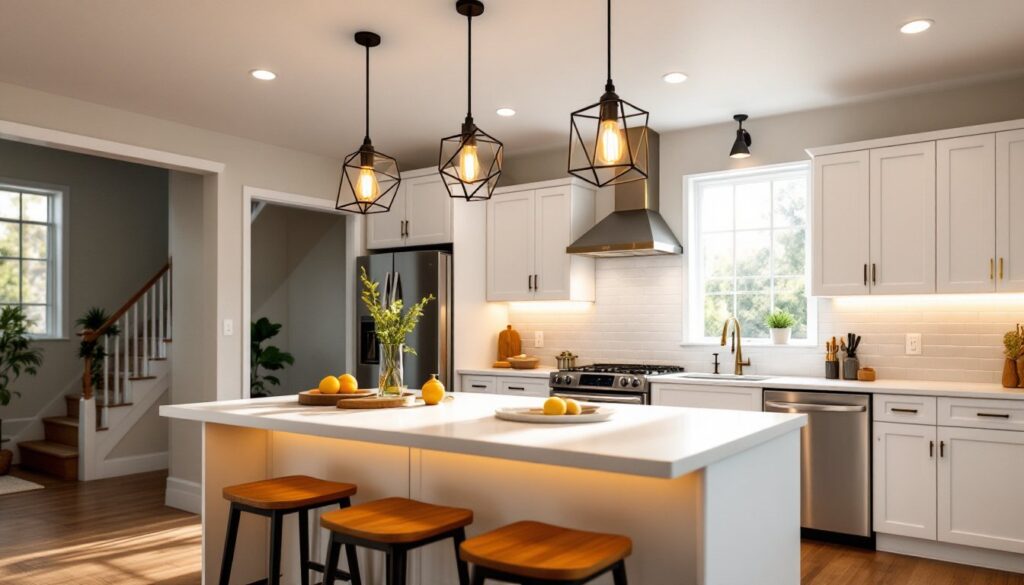
Pendant clusters work well over seating areas or coffee tables. Instead of one large fixture, hang three to five pendants at staggered heights. Cord length should be adjustable, most quality pendants include excess cord and a canopy that hides the slack.
Linear suspension fixtures, long, horizontal pendants, suit contemporary spaces with sectional sofas or long console tables. They create a visual bridge and work especially well in open-plan living rooms where you need to define zones without walls.
One safety note: if you’re installing a fixture heavier than 50 pounds, make sure it’s mounted to a ceiling joist or a fan-rated electrical box. Standard plastic pancake boxes aren’t rated for that load. If you’re not confident working with electrical boxes, hire a licensed electrician. A falling chandelier isn’t a DIY lesson you want to learn the hard way.
For more on selecting the right statement pieces, explore options among various fixture styles and applications suited to your room’s proportions.
Smart Lighting Controls for Modern Luxury Homes
Smart controls turn good lighting into great lighting by adding precision, convenience, and adaptability. In 2026, this isn’t optional for luxury living rooms, it’s expected.
Dimmer switches are the baseline. Install them on every lighting circuit in the room. For LED compatibility, use dimmers rated for low-voltage or electronic low-voltage (ELV) loads. Brands like Lutron Diva and Leviton Decora offer reliable performance with most LED fixtures. Avoid cheap big-box dimmers, they cause flicker and can shorten bulb life.
Scene controllers take it further. These let you program multiple lighting zones into a single button press. “Movie night” might dim recessed lights to 10%, turn off task lamps, and activate accent lighting behind the TV. “Entertaining” might bring ambient lights to 70%, add warmth from sconces, and highlight artwork.
Lutron Caséta and Control4 systems are popular for whole-home integration, but simpler options like Philips Hue or LIFX work well if you’re only automating a single room. Just confirm your smart bulbs or switches work with your existing wiring, some require a neutral wire, which older homes may lack.
Voice and app control add convenience but aren’t necessary for everyone. If you go this route, choose a system compatible with your existing smart home ecosystem (Alexa, Google Home, Apple HomeKit).
One overlooked feature: circadian lighting. Some systems automatically shift color temperature throughout the day, cooler (4000K) in the morning to boost alertness, warmer (2700K) in the evening to support relaxation. It’s subtle, but effective.
DIYers comfortable with basic wiring can install smart switches themselves. You’ll need a voltage tester, wire strippers, and a screwdriver. Always kill power at the breaker, not just the switch, and test before touching any wires. If your home has aluminum wiring (common in homes built 1965–1973), call a licensed electrician, special connectors are required, and improper installation is a fire risk.
For inspiration on layering different lighting styles and techniques, many designers now integrate smart controls into broader design strategies that balance aesthetics with automation. Similarly, achieving the right ambiance often involves selecting warm, adjustable lighting options that respond to time of day and activity.