Table of Contents
ToggleLighting a kitchen is more than swapping out a burnt bulb, it’s the difference between a gloomy prep space and a functional, welcoming room where your family actually wants to hang out. Home Depot has become the default stop for DIYers tackling kitchen lighting, offering everything from budget flush mounts to statement pendants, plus the expertise to guide first-timers through lumens, color temperature, and wiring basics. Whether you’re retrofitting an outdated fluorescent box or planning a full remodel, understanding your options will save you time, money, and second trips to return the wrong fixture.
Key Takeaways
- Home Depot kitchen lighting options range across three essential layers—ambient, task, and accent—allowing you to transform a dark space into a functional, welcoming room tailored to your family’s needs.
- Calculate lumens based on room size (50–75 lumens per square foot for ambient, 75–100 for task areas) rather than watts, and maintain consistent color temperature (3000K–3500K) across all fixtures to avoid an unintentional, disjointed appearance.
- LED integrated fixtures offer a superior return on investment, lasting 25,000–50,000 hours and using 75% less energy than incandescent bulbs, while under-cabinet strip lights and pendants over islands provide highly effective task lighting in work zones.
- Home Depot’s in-store expertise, 90-day return policy, year-round inventory, and access to licensed electricians make it the go-to for kitchen lighting projects, from simple fixture swaps to complex remodels requiring permits.
- Trending kitchen lighting styles now emphasize layered, purpose-driven designs with matte black and brushed brass finishes, geometric pendants, smart lighting integration, and trimless recessed LEDs that blend seamlessly into ceilings.
Why Home Depot Is the Go-To Choice for Kitchen Lighting
Home Depot combines product range, accessibility, and practical support in ways that smaller lighting boutiques and online-only retailers can’t match. The in-store experience lets you see fixtures at full scale, compare color temperatures side-by-side, and walk out same-day with everything from the fixture to the wire nuts.
Their lighting aisles stock thousands of SKUs across every price point, from contractor-grade builder packs under $20 to designer-adjacent pendants pushing $400. You’ll find major brands like Lithonia, Progress Lighting, and Hampton Bay alongside Home Depot’s house brands, which offer solid build quality at lower margins. The return policy (90 days for most items) takes the risk out of buying a fixture you’re not sure about until it’s hanging in your space.
Home Depot’s staff includes licensed electricians and long-time trade pros who can answer code questions, recommend compatible dimmer switches, and help you calculate how many recessed cans you need for even coverage. Many locations offer free workshops on basic electrical work, and their website includes wiring diagrams, installation videos, and lumens calculators. If you need a pro to handle the install, their contractor referral service connects you with local electricians, though you’ll want to vet them independently.
Inventory is another edge: Home Depot’s supply chain keeps popular fixtures in stock year-round, so you’re not waiting weeks for a backorder when you’re mid-project. Their online ordering with in-store pickup bridges the gap between browsing at home and getting hands-on before you commit.
Types of Kitchen Lighting Available at Home Depot
Good kitchen lighting works in layers, ambient, task, and accent, and Home Depot stocks fixtures for all three. Understanding the distinctions helps you avoid the classic mistake of relying on a single overhead light and calling it done.
Ambient Lighting Options
Ambient (or general) lighting is your baseline illumination, the layer that lets you navigate the room safely after dark. Flush-mount and semi-flush ceiling fixtures are the workhorses here, sitting tight to the ceiling in kitchens with standard 8-foot ceilings. Look for fixtures rated for damp locations if you’re installing near a sink or range.
Recessed lighting (also called can lights or downlights) is the go-to for modern kitchens. Home Depot carries both new-construction housings (installed before drywall) and remodel cans that clip into finished ceilings. Most DIYers will use 4-inch or 6-inch recessed cans: the latter works well for kitchens with higher ceilings or when you want broader light spread. Opt for IC-rated housings if the fixture will contact insulation in the ceiling cavity.
Track lighting offers flexibility for renters or anyone who wants adjustable light direction without cutting holes. Modern track systems use low-profile rails and swiveling heads: they’re especially useful in galley kitchens where a single track can cover both work zones and dining areas.
Task Lighting Solutions
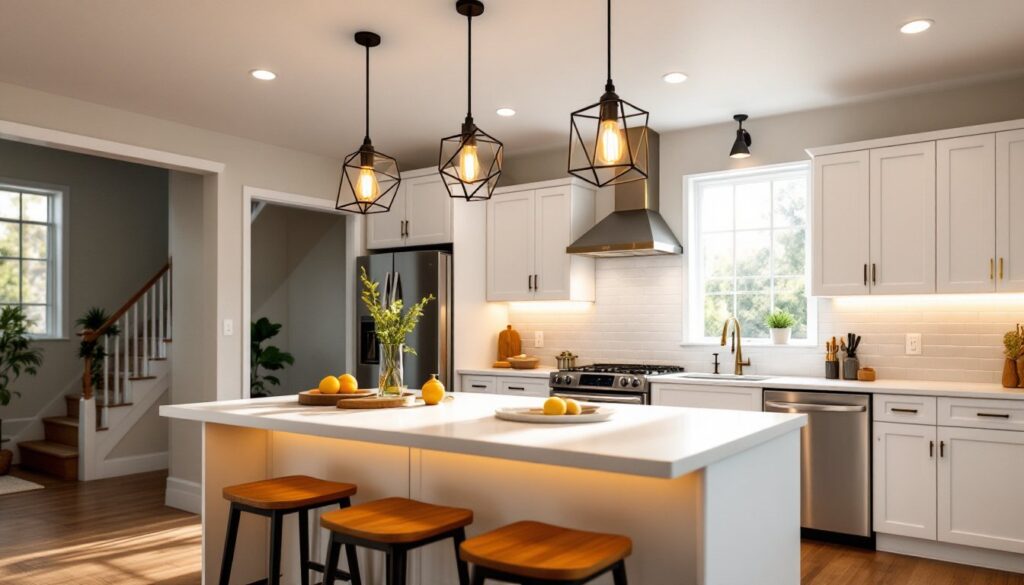
Task lighting targets specific work surfaces, countertops, islands, ranges, and sinks, where you need bright, shadow-free illumination. Under-cabinet lighting is the most common task solution, and Home Depot stocks puck lights, LED strip lights, and linkable bar lights.
LED strip lights (often sold as tape light) mount to the underside of wall cabinets with adhesive backing or clips. They’re low-profile, energy-efficient, and available in warm white (2700K-3000K) or daylight (4000K-5000K). Hardwired kits require basic electrical skills: plug-in versions are easier but leave a visible cord. Look for strips rated at 300+ lumens per foot for adequate task lighting.
Pendant lights over islands and peninsulas provide both task light and visual interest. Home Depot’s pendant selection runs from industrial cage styles to glass globes and mini-chandeliers. Hang pendants 30-36 inches above the countertop for islands: if you’re installing multiple pendants, space them 24-30 inches apart and center the group over the island, not each pendant individually.
For sinks without a window, a small recessed downlight or a pendant placed slightly off-center provides targeted task light. If you’ve got a window over the sink, task lighting there becomes less critical during daylight hours, but you’ll appreciate it for evening cleanup.
Accent and Decorative Fixtures
Accent lighting adds depth and highlights architectural features, glass-front cabinets, open shelving, or a tile backsplash. In-cabinet lighting (puck lights or small LED strips) showcases glassware and dishware while adding subtle ambiance. When installing inside cabinet lighting, consider whether you want lights that turn on with the cabinet door (using a pressure switch) or hardwired to a wall switch.
Toe-kick lighting is a newer trend: LED strips installed along the bottom edge of base cabinets create a floating effect and act as gentle nighttime navigation. It’s purely aesthetic but makes a surprising impact.
Statement fixtures, think oversized drum pendants, chandeliers, or multi-light linear suspensions, anchor dining nooks or breakfast areas within the kitchen. These aren’t strictly functional: they’re the jewelry of your lighting plan. Just make sure the style complements your other light fixtures throughout the home.
How to Choose the Right Kitchen Lighting for Your Space
Start with a lighting plan, not a shopping cart. Measure your kitchen, note ceiling height, and identify work zones before you step into the store.
Calculate lumens, not watts. The old watt-based guidelines died with incandescent bulbs. For ambient lighting, aim for 50-75 lumens per square foot. A 120-square-foot kitchen needs 6,000-9,000 total lumens. Divide that by the number of fixtures to determine lumens per bulb or integrated LED unit. Task areas need 75-100 lumens per square foot, so a 4-foot island workspace (roughly 10 square feet) wants 750-1,000 lumens from pendants or recessed lights.
Color temperature matters more in kitchens than anywhere else in the home. 2700K-3000K (warm white) feels cozy but can make food prep harder: 3500K-4000K (neutral white) balances warmth and clarity: 5000K+ (daylight) is clinical and best reserved for garage workshops. Stick to 3000K or 3500K for a kitchen that feels inviting but still functional. Ensure all your fixtures use the same color temperature, mixing 2700K and 4000K in the same room looks unintentional.
Dimmability adds flexibility. Dimmable lights let you dial down brightness for dinner parties or crank it up for detailed tasks like decorating cakes. Not all LEDs are compatible with standard incandescent dimmers: check the fixture specs and pair with a compatible LED dimmer switch (Lutron and Leviton both make reliable models sold at Home Depot).
Ceiling height and layout dictate fixture type. Kitchens with 8-foot ceilings work best with flush or semi-flush mounts and recessed cans: pendants should be reserved for islands or tables where head clearance isn’t an issue. For ceilings 9 feet or higher, you can use larger pendants, chandeliers, or longer drop rods without making the space feel crowded. According to HomeAdvisor’s kitchen lighting guide, spacing recessed lights is typically half the ceiling height, so in an 8-foot room, space cans 4 feet apart.
Energy efficiency and lifespan tilt heavily toward LEDs. Integrated LED fixtures (where the diode is built-in, not replaceable) last 25,000-50,000 hours and use 75% less energy than incandescent. The upfront cost is higher, but the math works out over a decade. If you prefer the option to change bulbs, buy fixtures rated for LED bulbs and stock up on compatible replacements.
Electrical work and permitting: Replacing an existing fixture on the same electrical box is straightforward DIY, turn off the breaker, disconnect the old fixture, connect the new one following the wiring diagram (black to black, white to white, ground to ground), and mount. Installing new circuits, adding recessed cans that require cutting into the ceiling, or moving a junction box typically requires a permit and may need a licensed electrician depending on local code. Check your jurisdiction’s requirements before you start drilling.
Top Kitchen Lighting Trends at Home Depot in 2026
Lighting trends cycle slower than paint colors but faster than cabinetry. Here’s what’s showing up in Home Depot’s featured displays and selling out fast in 2026.
Matte black and brushed brass finishes continue to dominate. Matte black works in modern farmhouse, industrial, and contemporary kitchens: brushed brass (sometimes called champagne bronze) adds warmth without the upkeep of polished brass. Mixed metals, black fixtures with brass accents, are common and look intentional when done sparingly.
Geometric and linear pendants have replaced the ubiquitous glass globe. Look for caged cylinders, hexagonal frames, and rectangular multi-light bars. Linear suspension fixtures (long, narrow pendants with multiple bulbs) work especially well over large islands and are available in lengths from 24 to 60 inches.
Smart lighting integration is moving beyond novelty. Home Depot now stocks fixtures compatible with Alexa, Google Assistant, and Apple HomeKit. You can schedule lights to turn on before you wake up, dim them via voice command, or sync color temperature to match natural daylight cycles. Philips Hue and C by GE both offer retrofit LED bulbs that screw into standard sockets, making any fixture “smart” without rewiring. Design inspiration from sites like Houzz shows how homeowners are layering smart controls across multiple fixture types.
Industrial-style fixtures, Edison bulbs, exposed filaments, wire cages, and barn-style shades, remain popular but are evolving. The trend now leans toward refined industrial: cleaner lines, smaller-scale fixtures, and LED filament bulbs that mimic Edison’s warm glow without the 60-watt energy draw.
Layered, purpose-driven lighting is replacing the single-source approach. DIYers are installing multiple fixture types in the same kitchen, recessed cans for ambient, pendants for task, and toe-kick LEDs for accent, and controlling them with separate switches or smart dimmers. This multi-layer strategy mirrors advice from kitchen design hubs like The Kitchn, which emphasizes flexibility and zoning.
Warmer color temperatures are making a comeback. After years of 4000K-5000K “bright white” dominance, homeowners are shifting back toward 3000K for a less sterile feel. Fixtures with tunable white LEDs (adjustable from 2700K to 5000K) offer the best of both worlds.
Minimalist recessed trims have replaced the chunky white baffles of the 2010s. Ultra-thin, trimless “canless” LEDs sit nearly flush with the ceiling and disappear visually, letting the light do the talking. Brands like Halo and Lithonia offer retrofit kits that clip into existing recessed housings, making upgrades fast and tool-free.
Exploring different styles of lighting helps you identify which trends fit your kitchen’s overall aesthetic, whether that’s sleek and modern or warm and traditional, without falling into the trap of chasing every passing fad.