Table of Contents
ToggleLinear pendant lighting has become the go-to solution for kitchen islands, and for good reason. It delivers focused task lighting exactly where cooks need it while acting as a statement piece that anchors the room’s design. Unlike traditional single pendants or flush-mount fixtures, linear lights span the length of an island, eliminating shadows and creating a cohesive visual line. Whether someone’s chopping vegetables at 6 a.m. or hosting a dinner party, the right linear pendant transforms both function and atmosphere. This guide walks through sizing, placement, style choices, installation steps, and smart features to help homeowners make confident decisions.
Key Takeaways
- Linear pendant lighting for kitchen islands distributes light evenly across the work surface, eliminating shadows and providing superior task illumination compared to single dome pendants.
- Size your linear pendant to be two-thirds to three-quarters the length of your island, with the fixture hanging 30–36 inches above the surface for optimal function and visual balance.
- Modern minimalist finishes like matte black and brushed nickel pair seamlessly with contemporary kitchens, while industrial and farmhouse styles work best with reclaimed materials and warm-toned bulbs.
- Dimmable linear pendants with LED-rated dimmer switches enable flexible mood lighting, allowing you to brighten for food prep and dim for ambient dining atmosphere.
- For installations over 25 pounds or smart features requiring a neutral wire, consult a licensed electrician to ensure code compliance and safe electrical connections.
- Always mock up the fixture size with painter’s tape before purchasing to confirm it complements your island proportions and doesn’t obstruct sightlines from seating areas.
What Is Linear Pendant Lighting and Why It Works for Kitchen Islands
A linear pendant is a horizontally elongated light fixture suspended from the ceiling by cords, rods, or a canopy. It typically measures anywhere from 24 inches to 60+ inches in length, designed to run parallel to a kitchen island’s longest dimension.
The physics are simple: a single point source (like a dome pendant) creates hotspots and shadows. A linear fixture distributes light across a broader plane, reducing contrast and improving visibility for tasks like slicing, reading recipes, or inspecting food. Most linear pendants house multiple bulbs or LED strips behind diffusers, which softens the light and reduces glare.
From a design standpoint, linear pendants emphasize the island’s role as the kitchen’s focal point. They create visual balance in open-concept layouts and work especially well in homes with light fixtures that emphasize clean geometry. For islands measuring 6 feet or longer, a linear pendant often performs better than multiple smaller pendants, which can look cluttered or compete for attention.
Most linear fixtures operate on standard 120V household current and connect to a standard junction box. Some high-output commercial-style units may require a dedicated circuit, so always check the fixture’s amperage rating before purchasing.
Choosing the Right Size and Placement for Your Island
The most common sizing mistake is going too small. A good rule of thumb: the fixture should be two-thirds to three-quarters the length of the island. For a 72-inch island, aim for a pendant between 48 and 54 inches long. Going shorter makes the fixture look like an afterthought: going longer risks visual heaviness unless the ceiling height supports it.
Ceiling height matters more than most DIYers realize. The bottom of the fixture should hang 30 to 36 inches above the island surface. At 30 inches, the light feels intimate and provides excellent task illumination: at 36 inches, it opens up sightlines and works better in kitchens with bar seating. For ceilings above 9 feet, add 3 inches of drop per additional foot of ceiling height to maintain proportion.
Center the fixture along the island’s length and width. If the island includes a cooktop or sink, adjust the fixture slightly toward the prep area rather than centering it over heat or water sources. In kitchens with two islands, each island typically gets its own fixture, sized independently.
Width is often overlooked. Linear pendants range from 3 to 12 inches wide. Narrower profiles suit minimalist or galley-style kitchens: wider fixtures make a bolder statement and work well in spaces with higher ceilings or dramatic cabinetry. Avoid fixtures wider than one-third the island’s width, or the proportions start to feel off.
Always mock up the size before buying. Tape painter’s tape on the ceiling in the fixture’s footprint and live with it for a few days. Walk around the island, sit at stools, and make sure it doesn’t block views or feel intrusive.
Top Styles and Finishes to Match Your Kitchen Design
Style isn’t just about looks: it’s about creating coherence with existing materials and finishes. Linear pendants come in enough styles to satisfy any aesthetic, from Scandinavian restraint to industrial grit.
Modern Minimalist Linear Pendants
Minimalist designs emphasize geometric simplicity and often feature metal or glass construction. Look for fixtures with integrated LED strips behind frosted acrylic or opal glass diffusers. These deliver even, glare-free light and pair well with flat-panel cabinets, quartz countertops, and stainless appliances.
Finishes in this category lean toward matte black, brushed nickel, polished chrome, or white powder coat. Matte black works especially well in kitchens with black window frames or cabinet hardware. Brushed nickel bridges modern and transitional styles, making it a safe choice for resale.
Some minimalist pendants use exposed LED strips without diffusers. These look striking but can cause glare if hung too low or if the LEDs are visible from seated positions. Test the viewing angle before committing, and check the fixture’s CRI (Color Rendering Index), aim for 90 or higher to accurately render food colors.
Industrial and Farmhouse Options
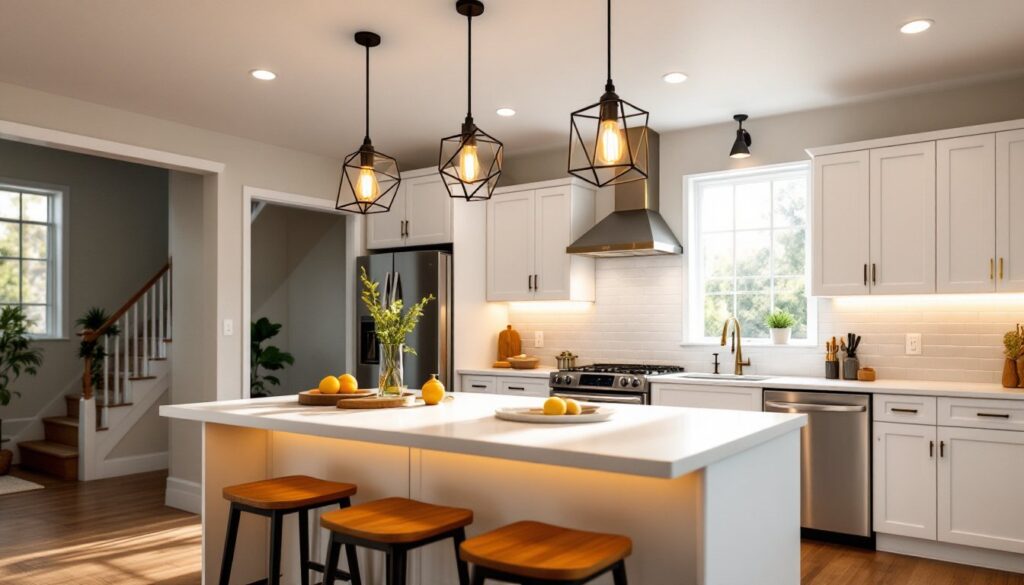
Industrial linear pendants often feature metal cages, Edison-style bulbs, and aged finishes like oil-rubbed bronze or weathered zinc. These fixtures add texture and warmth, working beautifully with reclaimed wood, exposed brick, or concrete countertops. Many use E26 medium-base sockets, which makes bulb replacement straightforward and allows for vintage-style filament bulbs.
Farmhouse styles incorporate wood elements, matte black metal, and clear or seeded glass. According to design resources like Houzz, these fixtures are especially popular in transitional kitchens that blend rustic and modern elements. They pair well with shaker cabinets, farmhouse sinks, and butcher-block countertops.
Be mindful of bulb exposure. Open-cage or exposed-bulb fixtures can produce harsh shadows and glare unless paired with warm-toned filament bulbs (2200K to 2700K). If the primary goal is task lighting, choose a fixture with some level of diffusion or shading.
Installation Tips for DIY Homeowners
Installing a linear pendant isn’t difficult, but it requires attention to detail and respect for electrical codes. Most jurisdictions follow the NEC (National Electrical Code), which requires a permit for new circuits but often allows fixture replacement on existing circuits without one. Verify local requirements before starting.
Safety first: Turn off power at the breaker, not just the switch. Use a non-contact voltage tester to confirm the circuit is dead before touching any wires. Wear safety glasses and work on a stable ladder.
Most linear pendants weigh between 8 and 25 pounds. Standard plastic junction boxes are rated for 50 pounds, but if the fixture exceeds that or if there’s any doubt, install a fan-rated box or a ceiling brace designed for heavier fixtures. The box must be securely fastened to a ceiling joist or blocking, drywall anchors won’t cut it.
Linear pendants typically connect via a canopy plate that covers the junction box. Inside, you’ll find three wires: black (hot), white (neutral), and green or bare copper (ground). Match these to the corresponding house wires using twist-on wire connectors. If the house wiring uses aluminum, consult an electrician: aluminum-to-copper connections require special connectors to prevent arcing.
Adjustable-height fixtures use cord or rod systems. Measure the desired drop before making final electrical connections, and trim cords to length if the fixture allows it. Some fixtures include a cord grip or set screw to lock the height: don’t skip this step, or the fixture will sag over time.
Once wired, tuck the connections neatly into the box and secure the canopy with the provided screws. Install bulbs (if not integrated LED), restore power, and test all functions. If the fixture flickers, check for loose connections. If it doesn’t light at all, verify the switch is on and recheck the circuit at the breaker.
For installations that require inside cabinet lighting or additional circuits, consider hiring a licensed electrician. Combining multiple circuits or adding dimmers can exceed typical DIY comfort zones.
Maximizing Functionality with Dimmable and Smart Features
Dimmable linear pendants offer flexibility that fixed-output fixtures can’t match. Dimming allows users to dial up brightness for food prep and dial down for ambient lighting during meals. Not all LED fixtures are dimmable, so confirm compatibility before buying.
LED dimming requires compatible components: a dimmable driver (built into the fixture), a compatible dimmer switch, and sometimes a minimum load. Older rotary or slide dimmers designed for incandescent bulbs often cause LED flicker or buzzing. Replace them with an LED-rated dimmer switch from manufacturers like Lutron or Leviton, which cost around $20 to $60. The packaging will specify compatible wattage and bulb types.
Test dimming performance across the full range before finishing the installation. Some cheap LED fixtures dim only to 30% or 40%, which isn’t low enough for true mood lighting. Higher-quality units dim smoothly to 5% or less.
Smart features are increasingly common in linear pendants. Wi-Fi or Zigbee-enabled fixtures integrate with platforms like Alexa, Google Home, or Apple HomeKit, allowing voice control, scheduling, and remote operation. For those exploring broader styles of lighting across the home, smart integration creates a unified control ecosystem.
Some smart fixtures include tunable white capability, which adjusts color temperature from warm (2700K) to cool (5000K). Warm tones enhance evening ambiance: cooler tones boost alertness during morning meal prep. A few high-end models add RGB color changing, though this feature is more novelty than necessity in a kitchen setting.
Installation differs slightly for smart fixtures. Most require a neutral wire at the switch box, which is standard in homes built after 2011 but may be absent in older construction. If there’s no neutral, consider a smart bulb solution in a standard fixture or hire an electrician to pull a new cable.
According to design and lifestyle resources like The Kitchn and Remodelista, homeowners increasingly prioritize lighting controls that adapt to daily routines. Pairing linear pendants with motion sensors or daylight sensors adds convenience without over-complicating the system.
For those investing in luxury lighting elsewhere in the home, a high-quality dimmable linear pendant with smart controls is a logical anchor for the kitchen. Expect to pay $200 to $800 for fixtures with robust feature sets and solid build quality. Cheaper units often skimp on driver quality, leading to premature failure or poor dimming performance.
Final tip: if installing recessed lights elsewhere, such as recessed lights for living room spaces, coordinate the color temperature and dimming capabilities with the kitchen pendant for a cohesive feel across open-plan areas. Mismatched color temperatures create jarring transitions that undermine the design.